What to visit in Faenza, the UNESCO Creative City of 2025 known for its ceramic art
In the province of Ravenna, halfway between Forlì and Imola, the splendid art city of Faenza , known worldwide for its tradition linked to the art of ceramics , enjoys a privileged location along the ancient Via Emilia, nestled right against the foothills of the Apennines. It is precisely this connection to the art of ceramics that has earned it a place on the UNESCO Creative Cities list for 2025. Inhabited since ancient times, with deep Etruscan and Roman roots, it still retains a beautiful medieval historic center, characterized by Renaissance and Neoclassical buildings, which encompasses historical and artistic treasures waiting to be discovered.
Although it's too often overlooked by tourist itineraries in the area, in favor of nearby Ravenna and Imola, for example, this corner of Romagna still offers the same vibrant emotions for which this ancient yet modern Italian province has always been famous: artistic and architectural treasures, genuine authenticity, family-like peace, and profound well-being. Let's take a look at what to see in Faenza.
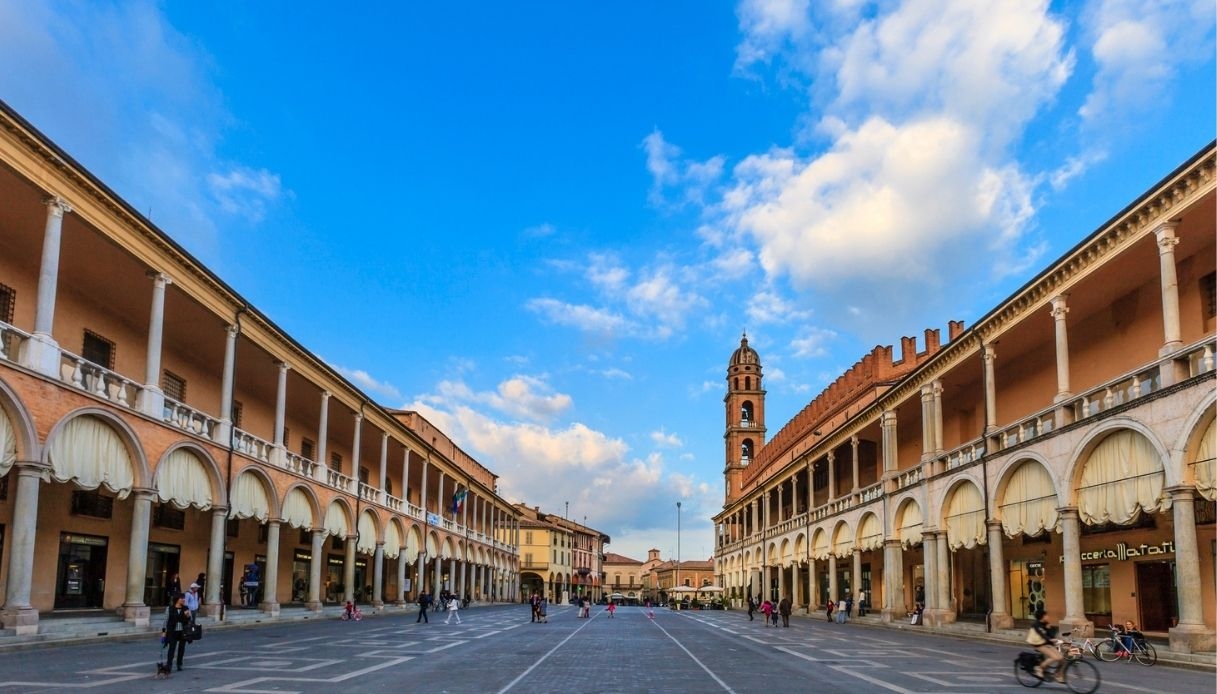
People's SquareThe ancient Piazza del Popolo , introduced by the imposing Clock Tower, a faithful copy of the 17th-century one destroyed during the Second World War, is bordered by elegant and graceful porticoes and represents the ideal and symbolic center of Faenza , the focal point of its civic life. The square, which still retains the form it assumed during the 15th century, is overlooked by some of the city's most important buildings, both dating back to the Middle Ages: the Palazzo del Podestà and Palazzo Manfredi , now the Town Hall. Also noteworthy is the elegant Voltone della Molinella, which connects the square to the 18th-century Masini Municipal Theater, located in Piazza Nenni: a precious umbrella vault decorated with grotesques in 1566 by Marco Marchetti.
Liberty SquarePiazza del Popolo is separated from Piazza della Libertà only by the straight path of Corso Mazzini and Corso Saffi, which however do not interrupt the continuity of the large space formed by the two, so much so that the people of Faenza refer to it simply as “piazza”.
Nonetheless, Piazza della Libertà retains its own precise and distinct identity, unabashedly eclectic, characterized by the imposing Renaissance façade of the Cathedral of San Pietro Apostolo , Faenza's cathedral, and the Baroque and monumental Fontana Maggiore (1619-1621), located at the side of the church, embellished with bronze sculptures by Tarquinio Jacometti. The fountain was built over a much older source, located at the end of one of the oldest aqueducts in all of Romagna.
Preceded by a wide staircase, Faenza Cathedral is characterized by its almost unfinished façade, which, when viewed closely, resembles San Petronio, Bologna's cathedral. The church, built between 1474 and 1515, represents one of the finest examples of Renaissance architecture in Romagna.
Inside, you can admire the 15th-century fresco in the chapel of the Blessed Virgin of Grace , depicting Mary breaking the arrows, the contemporary ark of Saint Emiliano adorned with refined marble reliefs (some of which are now preserved in Paris), and the canvas of the Blessed Virgin with Baby Jesus and Saints (1526), a work by Innocenzo da Imola. The elegant portico of the Goldsmiths closes the square on the opposite side.
The International Museum of Ceramics (MIC)The jewel in the crown of Faenza's history and artistic heritage is undoubtedly its world-famous artistic ceramics, so much so that it has been named a UNESCO Creative Cities 2025 along with La Spezia . The Faenza Ceramics Museum is undoubtedly the city's most important museum, as well as one of the most important in the world dedicated to ceramic art.
View this post on Instagram
Founded in the early 20th century following the 1908 Faenza International Exhibition, the museum, designated a UNESCO World Heritage Site as a Monument to a Culture of Peace in 2011, houses works from Italian ceramic workshops from the Middle Ages to the 19th century, as well as ancient ceramics from around the world, from the Hellenistic to the pre-Columbian and Islamic eras.
The museum tour concludes with an important section dedicated to modern and contemporary ceramics.
Laderchi PalaceThe charming historic center develops around the two squares with its haphazard network of narrow streets where the typical medieval urban layout is still clearly recognizable today.
Along these streets there are historic residences and elegant buildings, among which we remember the Zauli-Naldi palace (17th century) preceded by the singular loggia della Pagnotta, the contemporary Ferniani palace at the corner of which stands out a beautiful marble statue of the Immaculate Conception created by the Bolognese Ottavio and Nicola Toselli and the Laderchi palace, today home to the museum of the Risorgimento and the Contemporary Age, which preserves some precious decorations by the Piedmontese Felice Giani, among all the Gallery of Psyche (1794) and the Studiolo of Astronomy (1797).
Milzetti PalaceThe apotheosis of the neoclassical taste of the entire city of Faenza and, indeed, of the entire Emilia Romagna region is represented by the sumptuous Milzetti palace .
This historic building, designed and erected by architect Giuseppe Pistocchi in the late eighteenth century above a cluster of older homes damaged by an earthquake, is truly a marvel to behold.
The decorations that grace the halls and rooms of the palace represent a unique artistic and expressive richness . Just think of the Gallery of Achilles, or the large octagonal hall known as the Temple of Apollo, which house refined reworkings of ancient Renaissance grotesques painted in tempera on the walls by the Piedmontese painter Felice Giani (1758-1823).
View this post on Instagram
The subjects are inspired by Greek mythology, such as the wonderful fresco by the brothers Francesco and Giovan Battista Ballanti Graziani depicting Priam asking for the return of Hector's body.
Outside, a lush and vast garden extends, home to a unique rustic cabin with 19th-century trompe l'oeil decorations by Faenza artist Romolo Liverani. Since 2001, Palazzo Milzetti has housed the Museum of the Neoclassical Age in Romagna.
Oriolo Tower of the FigsAnother iconic monument of Faenza , although located about 10 km from its historic center, is undoubtedly the unique medieval Oriolo Tower, located in Oriolo dei Fichi . Its hexagonal, double-strut plan, with two points at right angles and the others at obtuse angles, means that when walking around the tower, it appears square or octagonal, depending on your perspective. The building is 17 m tall, plus 11 m underground. The levels are also connected internally by a perfectly preserved sandstone spiral staircase.
Where it is and how to get thereFaenza is a city in Emilia-Romagna. It stands out for its strategic location between Bologna and Rimini and is part of the province of Ravenna . It is easily reached by car, exiting at the dedicated highway exit, or by train on the Bologna-Rimini line.