

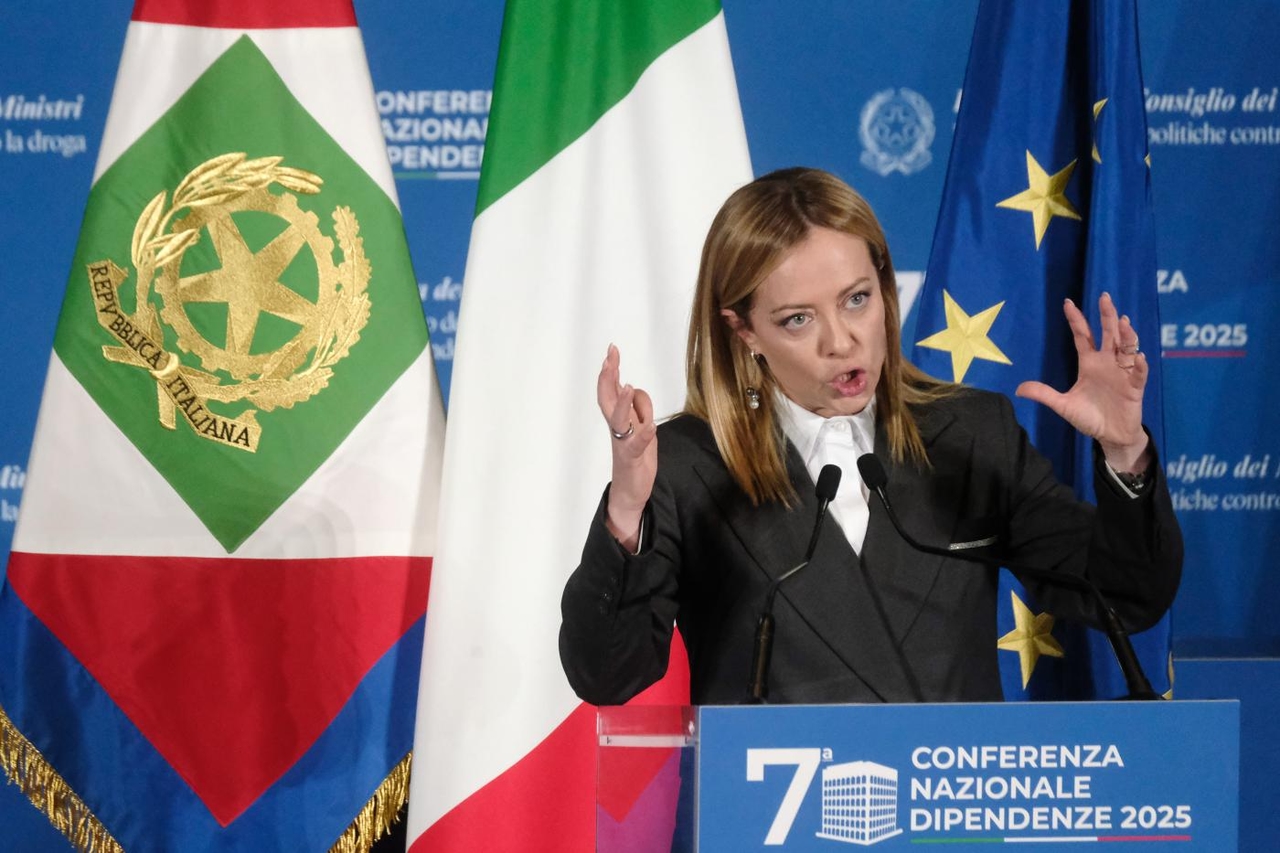
"Never a wealth tax," Giorgia Meloni defends the wealthy and lashes out against the CGIL proposal.
The CGIL proposal
"Never as long as the right governs," thunders Giorgia. She thus dodges the pro-wealth maneuver. But the left remains timid. And Conte rejects Landini.
In Italy, no word is more unpronounceable than "wealth tax." It's not a question of technical objections, which might be reasonable, since in Spain a wealth tax similar to the one proposed by Landini generated revenues far lower than the €26 billion estimated by the CGIL secretary. It might therefore be necessary to better focus the objective and rework the instrument. But the problem doesn't arise because the goal would still be to tax the wealthiest , and this is what, out of ideological dogma and not out of concrete doubts, is considered blasphemy. Not just by the right-wing government, but by the entire establishment.
Giorgia Meloni and Economy Minister Giorgetti are therefore playing a counterattack, convinced that the word "tax" will sting most Italians, not just the super-rich, and will oppose it. The prime minister makes her opposition to the wealth tax a flag to wave proudly: "As long as the right-wing governs, it will never exist." The minister plays on the fears of the middle and even lower-middle classes: " In the budget, we tried to help not the rich, but the middle class. Anyone earning €2,000 net is not rich. They've massacred us, but we're right." These words reveal the government's predicament, after all the economic institutions have labeled the budget as unfair and, in any case, gloss over Landini's proposal for a wealth tax for the richest 1%. But it's almost natural for the right to consider the wealth tax a word and proposal that should be banned. Especially since the right, while it once cloaked itself in a social veil, has long since shed it. But if the opposition also adopts similar tones, or at least shies away to avoid having to express itself on the damned proposal, things are different. In reality, it is precisely the reluctance, or at least timidity, of the left, compared to the dogmatic boldness of the right, that creates the widespread misconception that allows the prime minister to reject a law dictated by common sense without, so far, paying any price in terms of consensus.
Conte is a standout from this point of view: " Meloni wanted to write a post about a wealth tax. She should resign herself. For us, a wealth tax is not on the agenda; instead, it's the government's responsibility to manage taxes. Let's not distract citizens from the real problems." Elly Schlein is less peremptory. She doesn't say no to Landini 's proposal, but she doesn't even mention it. She claims that " Meloni is on the side of the rich ," but she also points the finger at "the tax burden, which has risen to 42%." Boccia also shies away from the unmentionable topic: "Meloni has only introduced a wealth tax: it's the tax on social injustice." Renzi then becomes peremptory: "Talking about a wealth tax is yet another own goal for the left. So Meloni, after raising taxes to 42.8%, is coming out of the corner and going on the offensive, saying no to a wealth tax."
Landini insists: " Saying no to the wealth tax is a political choice: it means privileging 500,000 wealthy people over 40 million taxpayers." But the reality is that the CGIL secretary has remained isolated, not because the entire broader coalition disagrees with him, perhaps with the exception of Conte , who constantly needs to emphasize his distance from the left. Rather, it's because of the fear that the argument will be counterproductive, that it will frighten voters—not just the wealthy ones but also those who would have everything to gain from a tax on large fortunes—and that it will irritate the media and their editorialists.
Thus, a scenario we've seen many times in recent decades is being repeated, albeit in a softer form. Fearing displeased a segment of the electorate, the center-left either follows its opponents on their own turf, as many are pushing for yet another time on the issue of security, or avoids taking sides too openly and clearly. But this is a strategy that has never paid off over the decades, and is the opposite of the direction the Democratic Party secretary is trying to steer her party toward. Dropping that proposal would be a terrible idea for the left.


l'Unità


