
Centering Nurses Amid Evolving Tech Adoption in Healthcare

When it’s time for Mayo Clinic to evaluate technology that will support the clinical workforce, features and form factors aren’t the only consideration.
“Using technology isn’t the goal,” says Cheristi Cognetta-Rieke, vice chair of enterprise nursing practice transformation at Mayo Clinic. “Transforming nursing practice and elevating patient care is the goal.”
Cognetta-Rieke refers to Mayo Clinic’s “for nurses, by nurses” model, which aims to embed frontline clinicians in the process of designing the tools they will ultimately use. That way, she says, “technology can amplify our human experience, our critical thinking and assessment capabilities, rather than replace it.”
As Mayo Clinic and other healthcare organizations refine their approaches to building technology for nurses, they’re also rethinking training and education, starting in medical school.
It’s a critical time for the industry to amplify the nursing experience. Research shows that annual job turnover for registered nurses exceeds 16%. What’s more, new nurses are caring for an aging population with complex conditions and confronting care documentation burdens.
“The more we learn about cognitive load, the more we see the challenges clinicians face by carrying so much information in their heads,” says Dr. Margaret Lozovatsky, chief medical information officer at the American Medical Association and the group’s vice president of digital health innovations.
That’s why Mayo Clinic assembles key stakeholders before building technology, Cognetta-Rieke says: “Technology and informatics can’t solve clinical pain points without clinical input. We need to bring them together from the beginning so we can first deeply understand the problem.”
Tonychris Nnaka agrees. He’s the associate dean for research and associate professor of nursing at UNT Health Fort Worth’s College of Nursing, and he emphasizes the role of establishing a “clear line of partnership” between academic and nursing settings.
“Leading institutions are bringing together biomedical engineers, computational engineers and the clinical arm,” Nnaka says. Collaboration with technology industry, community and government partners is a plus, but it requires commitment from senior leadership.
However, organizations that succeed in bridging gaps, Nnaka adds, are “breeding an environment where these groups can coexist, brainstorm, come up with a viable solution that’s clinically meaningful, and fund it.”
DISCOVER: Harness the power of data and AI to transform healthcare delivery.
Tech Adoption Must Meet Business NeedsThe process Nnaka describes sets the stage to address one of healthcare’s most pressing challenges: aligning technology with business needs.
“You need clear governance and decision-making structure, and you need to make sure the governance model aligns with your organization’s top strategic initiatives,” Lozovatsky adds.
Organizations should create a problem statement and look for technology that meets that need, notes Kerry O’Brien, senior director of clinical systems at NYU Langone Health. That means asking key questions: Does it support quality, safety and excellence? Does it integrate with clinical workflows? How will it improve the patient experience?
Ambient clinical documentation is one type of technology that has met the brief. Alice Nash, senior director of nursing professional development and clinical outcomes at NYU Langone Health, says it’s more than just facilitating data collection.
“Nurses can do a head-to-toe assessment while also being present. Patients aren’t asking questions from behind a screen, and they can see the nurse’s body language. It’s more inviting and nurturing,” she says.
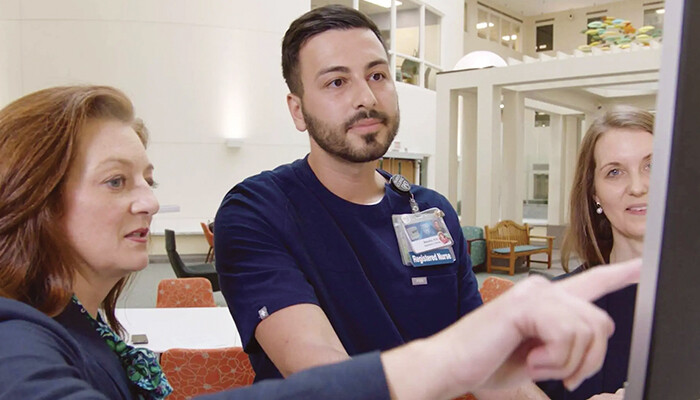
“Transforming nursing practice and elevating patient care is the goal.” — Cheristi Cognetta-Rieke, Vice Chair of Nursing Practice Transformation, Mayo Clinic Enterprise
As one of the tools that has seen wider adoption in healthcare, it also offers more insight into a nurse’s role. “It makes visible things about the art and science of nursing that hadn’t been visible before,” O’Brien says.
Another solution that has seen growth is virtual nursing. A number of healthcare organizations have adopted or refined their virtual nursing models in recent years amid workforce constraints and challenging care expectations. Artisight and Caregility are just a couple of the platforms supporting workflows between remote and bedside nurses.
Nnaka notes that virtual nursing has even more potential to shift care from within hospital walls into a patient’s home. It’s an innovative model for increasing access to care, but it comes with a learning curve.
“You need to train nurses to adapt to the environment,” he says. “You don’t want them to be blindsided with a virtual nursing tool. They need true simulation when they’re training.”
A Shift Toward Workflow-Driven TrainingAll of these changes in nursing demonstrate the need for a multipronged approach to education, one that combines traditional educational materials and “at the elbow” support with click-through modules, instructional videos and simulations, Cognetta-Rieke notes.
“No one wants to feel clunky using technology with a patient for the first time,” she says. “You need touch-feel practice so you can feel both competent and confident with the new tool.”
This points to a larger trend in technology training, Lozovatsky says. Large-scale sessions in lecture halls have given way to shorter, virtual and personalized learning opportunities. These can be tailored to the trainee’s previous tech experience, or to a group’s unique implementation of an application. There has also been a shift from training that’s functional, emphasizing which dials to turn, to training tied to specific workflows, such as admitting or discharging a patient.
Lozovatsky notes that many organizations are revisiting how technology training fits into employee onboarding.
NYU Langone Health is one of them: Surveys showed that neither new nurses nor preceptors were satisfied with electronic health records system training, O’Brien says. The problem? They were covering the nuances of the EHR too early in orientation. In response, NYU Langone Health kicked off onboarding with conversations about safety and quality, then conducted EHR training. O’Brien says nurse preceptor satisfaction scores increased from 35% to 80% after the change.
Click the banner below to sign up for HealthTech’s weekly newsletter.
NYU Langone Health’s example illustrates that when it comes to implementing new tools and systems, the biggest barrier to change is no longer the technology itself.
“It’s really about preparing people to adopt new ways of doing things and seeing where the technology is headed,” Nnaka says. “We have to prepare systems to adapt to the evolutions going forward because systems are slow to move.”
For Mayo Clinic, the emphasis is where technology can transform patient experience, care and nursing practice, Cognetta-Rieke says. “We need to make sure relationship-based and conversation-based care remain tried and true, and we strive to build technology to support and amplify that.”
Nash agrees, noting that NYU Langone Health “strives toward new innovation and technology to help support the work of our nurses and elevate our standards.” Those include patient satisfaction scores, clinical outcomes and maintaining a positive place to work.
“Nurses can really go anywhere,” she says. “We want to make this an environment where nurses feel valued and feel like their work is important.”

healthtechmagazine