25 Best Thin Hair Mullet Haircut Ideas to Try This Year


This before-and-after really shows what a well-executed shag mullet can do for thin, long hair that’s lost its purpose. The before photo has all the hallmarks of fine hair just existing, no real shape, no movement, just length hanging there. The after has curtain bangs that frame the face, aggressive layering through the crown that creates instant height, and textured ends that flick outward with intention. The hair didn’t get thicker, it just got a shape that works with its density instead of exposing it. This is the version I’d show a stylist if I wanted a mullet that leans more shag than punk, because the proportions are flattering without being safe.

If this is a perm and not natural curl, it’s a well-done one, because the curl pattern looks consistent and healthy through the entire length. Either way, curly mullets are the best-kept secret for thin hair. The curls create their own volume and the mullet shape keeps everything from turning into a shapeless cloud. The fringe here has the same curl pattern as the rest, which gives it a cohesive look rather than the awkward contrast you sometimes see when people try to straighten their bangs against a curly cut. This would be a low-maintenance option in terms of daily styling, though if it is permed, you’ll want to avoid sulfate shampoos.

This borrows from the Chelsea cut tradition, with the heavy fringe and the exposed temples, and merges it with a mullet back. It’s not for everyone, and I wouldn’t pretend otherwise. The extreme thinness at the sides where the hair was either shaved or is naturally very sparse creates a stark contrast against the dense bangs and longer back sections. If you have thin hair mostly at the temples and sides but decent density on top and in back, this kind of cut actually works with your natural growth pattern rather than fighting it. The jet black color makes every strand visible and graphic, which is either exactly what you want or the opposite.

This is all about the color and the texture working together. The hot pink is saturated and even throughout, which takes effort on pre-lightened hair, and the feathered layers in back create a lot of movement for what’s clearly fine hair. The bangs are kept slightly longer than the crown, which creates a layered effect across the top of the head rather than the standard short-on-top approach. I’d love to see how this looks grown out by about three inches, because I suspect the shape would transition into something equally interesting rather than falling apart.

There’s a European editorial quality to this one that I find really appealing. The blunt micro bangs, the little wisps at the ears, the very short tail at the nape, it all feels considered without feeling overdone. The golden strawberry color is warm and natural-looking, which softens what could otherwise be a pretty severe silhouette. On fine hair, this kind of very short mullet works because there isn’t enough length for gravity to flatten anything. Everything stays where it was cut, and the shape holds all day without product.

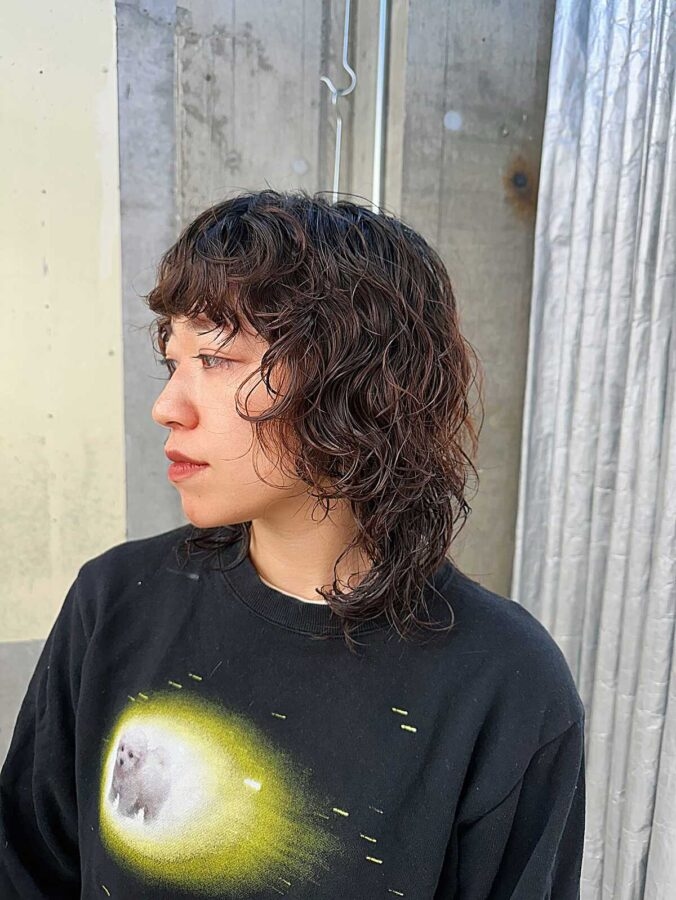
This is one of those cuts that makes me want to grow my hair out and perm it, which I say knowing full well I’d regret it within a month. But the shape is genuinely beautiful. The bangs are curly and sit just at the forehead, the layers around the face create a rounded frame, and the long curly back has enough density to look full without being heavy. What makes this work on thinner hair is that the curls are tight enough to stack on each other and create the impression of volume. If your hair is both thin and straight, you would not get this result without chemical or heat assistance, so keep that in mind.

The shaved sides take this into a different territory than most of the other cuts here, and on naturally curly thin hair, it’s a smart structural decision. All the density gets pushed to the top and back where it can pile up and create that wild, full silhouette, while the sides stay clean and defined. The curls look like they have a lot of natural spring to them, and the length in back is long enough to create real drama without weighing anything down. This is a high-commitment cut in terms of maintaining the shaved sections, since they’ll need buzzing every couple of weeks, but the actual styling of the longer hair is essentially wash and go.

The warm highlights running through this one give it a sun-kissed quality that makes the thin ends look intentional rather than scraggly. The baby bangs are straight while the rest of the hair has a soft wave, and that mix of textures is actually more interesting than if everything matched perfectly. The layers through the top are short enough to stand up on their own, which creates that rounded crown shape that thin-haired women are usually chasing with volumizing products. Here, the cut does the work instead.

The contrast between those tiny, tight bangs and the long curly back is dramatic, and it takes a certain kind of face to carry it. The curls are well-defined and clearly well cared for, which is what saves the longer sections from looking thin. When curly hair is dry and frizzy it tends to spread out and lose density, but when it’s properly moisturized and defined like this, each curl acts as its own little volume unit. The very short bangs open up the entire forehead and change the proportions of the face, which can be amazing or can be a lot, depending on your features. I’d suggest asking your stylist to leave the bangs a bit longer than you think you want, because they’ll shrink up as they dry if you have any wave at all.

This barely reads as a mullet at first glance, and I think that’s exactly the point. The layers are graduated enough to give it that shorter-in-front, longer-in-back shape, but the soft waves and natural brown color keep it grounded. This is the version I’d recommend to someone who keeps saying “I want a mullet but I’m scared,” because the grow-out is forgiving and the day-to-day styling is essentially just letting your hair air dry. A little sea salt spray scrunched in while damp would enhance those waves without any heat.

Of everything in this collection, this might be the most wearable version for someone who wants a mullet that doesn’t announce itself. The bangs are straight-across but softened at the edges, the layers are structured without being choppy, and the overall shape has a kind of ’70s refinement to it. On thin hair, this more polished approach avoids the risk of looking scraggly that over-textured cuts sometimes create. The flip side is that smoother mullets like this tend to show greasy roots faster, so a good dry shampoo will earn its place on your shelf.

This is about as short as a mullet can go while still being recognizably a mullet, and for thin hair, that brevity works in its favor. There’s very little length to weigh anything down, so the natural texture of the hair, which looks like a slight wave, gets to do its thing without interference. The bangs are chopped and imperfect and the whole thing has a kind of joyful energy to it. I wouldn’t call this one versatile in the styling department since there’s not much you can do with hair this short, but the upside is that it takes about thirty seconds to deal with in the morning and it always looks like it’s supposed to look messy.

The undercut at the temple is subtle here but important, because on thin hair, having all that fine hair stacking around the ears tends to look flat and lifeless. Removing it opens up the silhouette and lets the longer back pieces sit with more intention. The blonde has some lowlights running through it that prevent it from reading as one flat tone, and the choppy ends give the back section texture without sacrificing too much length. This is a practical mullet in the best sense: it looks good, it’s not high-maintenance, and it suits a lot of different lifestyles.

This is a great example of how a mullet can stay compact and still read as a mullet. The shaved sides take weight out of exactly the right places, and the longer pieces at the nape give just enough tail without overwhelming the overall pixie shape. That lilac-silver tone is doing real favors here too, because on fine hair, a pastel like this actually photographs with more dimension than a solid natural color would. The texture through the crown was clearly done with a razor or point-cutting to keep it airy rather than blunt, which is exactly the approach thin hair needs. This would grow out well for about six weeks before the sides start looking shaggy, so plan your trims accordingly.

The color blocking here, black roots fading into green through the mid-lengths and ends, creates an optical illusion of depth that thin hair desperately benefits from. The bangs are cut straight across and quite short, which is a bold choice with a round face shape, but the wavy length through the back balances it out by adding vertical movement. This cut requires maintenance on two fronts: the bangs will need trimming every few weeks, and green is one of the fastest fashion colors to fade, so a color depositing conditioner between salon visits would help.

I like how this one feels lived-in rather than freshly cut. The sandy blonde has some darker roots coming through, which adds visual weight at the scalp and makes the whole thing look thicker than it probably is. The length hits right at the neck, which is a forgiving spot for thin hair because it’s long enough to have presence but not so long that gravity pulls it flat. The bangs are side-swept and a little uneven in a way that looks like she cut them herself between appointments, and honestly, that kind of imperfection is half the charm of this cut.

There’s something about this one that feels very approachable, almost like a pixie that just kept going a little at the nape. The layering through the top is textured enough to create volume but not so aggressive that you’d lose coverage. The bangs sit nicely on the forehead without looking sparse, which can be a real concern with thin hair. This is the kind of mullet you could grow out relatively gracefully if you decided it wasn’t for you, which isn’t something you can say about most of the cuts on this list.

The wavy-curly texture here is doing most of the work, creating fullness where the hair is thinnest and giving the short layers on top something to grip onto. That little blonde panel near the ear is a subtle but effective detail that draws the eye and creates the impression of more dimension. The crop through the top and sides is tight, almost bowl-like, which contrasts nicely with the looser curls in the back. If your thin hair has any natural curl to it, this is a really smart direction to consider because the curl pattern fills out the shape in a way that straight thin hair simply can’t on its own.

This is one of the more understated mullets in this collection, and I think it’s quietly one of the best ones for someone who’s new to the cut. The bangs are choppy but not severe, and the layers transition softly from the short top into the longer back. It doesn’t scream mullet, which might be exactly what you want if you work in an environment where a more dramatic version would feel out of place. The hair looks genuinely fine here, and the fact that it still has shape and movement speaks to good interior layering.

The shaved temple here is doing more than just making a visual statement. On thin hair, removing bulk from the sides entirely lets you redirect all of your density toward the top and back, where it actually counts in a mullet. The curly texture in the back gives this a wild quality, and the purple streaks at the bangs and ends tie the whole thing together without requiring a full color commitment. The fringe pieces are cut in a deliberate tendril style that frames the face, and that particular technique works really well on finer hair because the individual pieces create a graphic effect.

This is going to be a polarizing one, and I respect that. The extreme length difference between the cropped blonde top and the long dark tail is about as far as you can push the mullet concept, and it’s not something most people would feel comfortable wearing. That said, on thin hair this kind of radical disconnection actually solves a problem: you get all the short-hair benefits on top (volume, shape, easy styling) and keep the long-hair option in back without having to maintain length everywhere. The two-tone color makes it read as very intentional. This is a lifestyle cut, not a trend cut, and it requires a certain confidence to pull off daily.

The color is doing a lot of heavy lifting here, but even under all that purple, the bones of this cut are solid. The layers through the top are short and heavily textured, which creates a piecey, almost spiky effect that adds height and visual density. The tail is kept at a medium length and tapered at the ends so it doesn’t drag. I’ll say that vivid colors like this require pre-lightening, and pre-lightened thin hair needs serious aftercare. A good Olaplex No. 3 routine will be your best friend if you’re going this route. But the texture this cut achieves is genuinely impressive for what looks like finer hair.

Longer mullets on thin hair are tricky because the tail can start looking stringy past a certain point, but this one manages it by keeping the layers soft and relatively close together in length. The micro bangs commit the whole look to its direction, and I think that commitment is what makes it work. If you went halfway with curtain bangs or a longer fringe, this cut would just look like a bad layered haircut. The dark color helps maintain the appearance of density through the length, and the slight wave in the mid-lengths breaks up what could otherwise be flat panels of hair.

From this angle you can really see how the layering creates movement even on what looks like quite fine hair. The short pieces at the crown push forward and give height, while the longer back pieces flip out at the ends on their own. That kind of natural kick at the bottom is a gift when you have thin hair because it creates the illusion of more volume without any product or heat. The platinum blonde does make the hair look thinner at the ends than it probably is in person, which is worth considering if you’re already worried about transparency. A slightly warmer blonde or leaving some root shadow would thicken things up visually.

This sits right at the intersection of shag and mullet, which is where a lot of the best thin-hair versions end up. The bangs are full and blunt enough to anchor the front, and the layers through the sides and back are wispy without being see-through. What I appreciate about this one is that it doesn’t try too hard. It looks like hair that was cut well and then left alone, which is exactly the vibe you want when you don’t have a ton of density to play with. The natural color helps too, since there’s no damage pulling the texture in weird directions.

Latest Hairstyles