Even I need lessons to master AI - and I'm the boss of Google
Updated:
Everyone in Britain seems to be struggling to find the time to keep up with AI – and that includes the boss of Google.
Kate Alessi, the company’s managing director for the UK and Ireland, carves out three hour-long slots in her diary every week to experiment with her company’s artificial intelligence tools.
She is one of only a few female executives to have reached the top of Big Tech, which remains very much a man’s world.
Google has discovered mid-life women in Britain face a fresh hazard at work. As if their lives were not already difficult enough, they are now at risk of being left in the slow lane by a new breed of young, male AI ‘super users.’
These individuals are mastering the technology to grab promotions and pay rises, while fifty-something female colleagues lag behind.
Britain has ‘extraordinary potential’ to be a leader in artificial intelligence, Alessi believes, but we need to nip this gender tech inequality in the bud.
Uphill struggle: Everyone in Britain seems to be struggling to find the time to keep up with AI – and that includes the boss of Google
Three quarters of us are using AI, but many of us are only scratching the surface. More sophisticated users, the majority of whom are men, make up just 15percent of the total.
Only 4 per cent of women aged over 55 are advanced AI users and nearly a quarter say they would not know where to start.
Alessi, who has teenage boys, does not disclose how old she is. That silence in itself speaks volumes about ageism and sexism.
‘‘There is a risk existing inequalities will become more entrenched so it’s important we address this, but the good news is that it is very solvable. It is quite simple for anyone to use AI skills’ she says.

Women, she says, are far more likely to shy away from using AI at work unless their employer has given express permission.
‘There is a confidence issue.’
‘Our research shows men were more willing to skirt the policies than women were,’ she says. ‘Employers could help by giving more clarity.’
‘We need to focus on the fact 85 per cent of people in the UK are not using AI to its full potential, and to concentrate on giving everyone the skills they need, no matter women or men, young or old, urban or rural,’ she says.
As well as using AI tools to sift vast amounts of data at work Alessi herself has been using it to help with the gardening at her new home in north London.
‘I don’t know what any of the plants are, so I turn it on, walk around the garden and ask it what are these flowers, when do they bloom, and how often should I water them.’
Google’s latest economic impact report estimates that its products, platforms and tools supported £140billion of activity across the UK in 2025, an increase of 20 per cent on 2023.
That is equivalent, Alessi says, to the economy of Greater Manchester, possibly in a nod to prime minister presumptive Andy Burnham’s north-western heartland.
‘The UK is in an extraordinary position to be a leader in AI. We have the best universities here, we have incredible infrastructure and tech here, we have incredible entrepreneurs here.’
‘But we need to move quickly because some countries are going faster. Singapore is way ahead in AI. We need to make sure it is adopted in the right way across the whole country.’
‘There is more the government can do to drive adoption in the public sector workforce. Right now 50 per cent of people in the public sector have had no AI training. That could make a huge difference.’
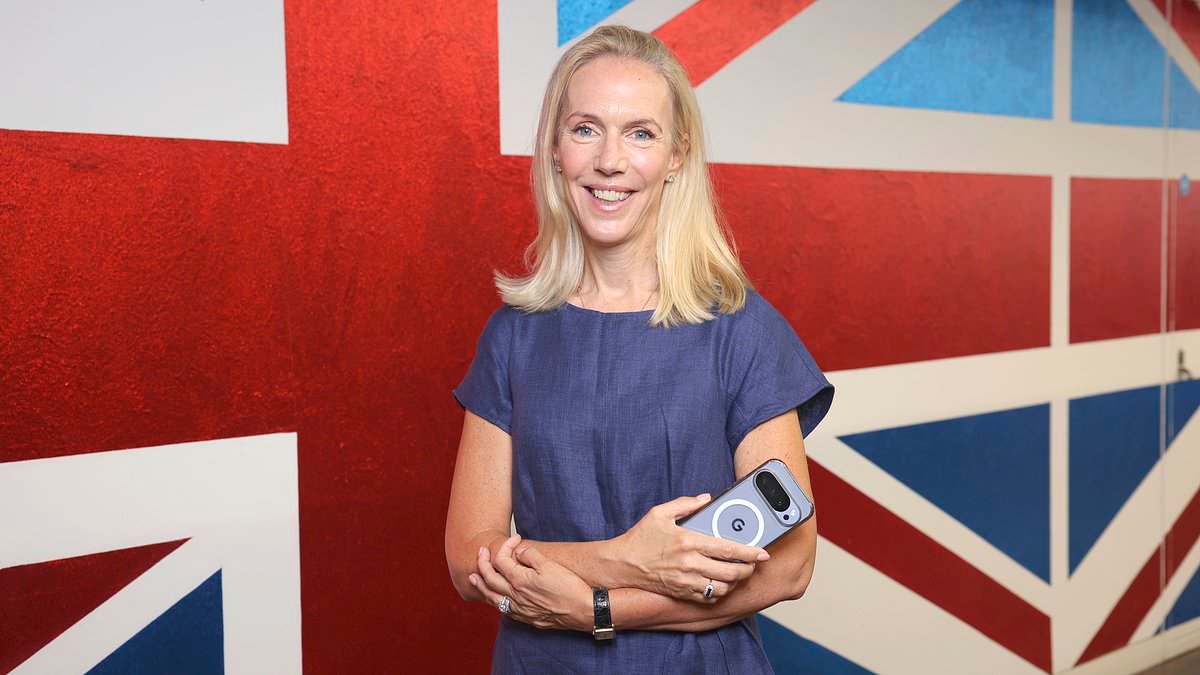
Top job: Kate Alessi is Google's managing director for the UK and Ireland
Could AI be the answer to our growth problems? ‘Exactly. The whole country needs to focus on this.’
Alessi is an American Anglophile who previously worked in Canary Wharf in the 1990s and returned from the US to London in June 2025 to take charge of Google UK and Ireland.
She succeeded Debbie Weinstein, who was promoted to oversee the company’s wider European, Middle Eastern and African operations.
The beating heart of Google’s push into AI is London-based DeepMind, a business founded by British scientists that was bought by the US tech giant for a reported $650million in 2014.
The sale of British tech companies is a touchy subject.
Andy Haldane, president of the British Chambers of Commerce, recently said the UK has created a ‘death valley’ for such businesses by selling them to foreign buyers just as we sit on the cusp of an AI revolution.
That, according to some estimates, is leading to an estimated loss of £1trillion of value.
So how does Alessi think we can make sure more of the value created in Britain stays here?
‘We are very proud Google DeepMind is here in the UK and it will continue to be here,” says Alessi.’
Lives: North London
Drives: Volvo
Family: Husband and three boys.
Education: Princeton University, MBA from Harvard Business School.
Career: 16 years at Google in leadership roles across the globe.
Hobbies Gardening, hiking, kids’ activities.
Best thing about living in London? Incredible, easily accessible cultural events
Favourite book: Recently read The Correspondent, which I really enjoyed.
Who, living or dead, would she invite to a dinner party and what would she serve? I would invite my grandmother and serve Ina Garten Chicken Marbella.
‘We are deeply committed to the UK. We have been here over 20 years and we have 7,000 people here. We have invested huge amounts. We recently announced a £5bn investment in the UK and the total goes way beyond that.’
She mentions Platform 37, Google’s new building near King’s Cross, scheduled to open this year.
The name is part reference to the nearby train station and part homage to ‘Move 37’, a play made by DeepMind’s AlphaGo AI system, which defeated human champion Lee Sedol at Go.
The victory, ten years ago, was reminiscent of IBM’s Deep Blue computer beating Garry Kasparov at chess in the 1990s, except Go, a Chinese game, is much more complicated.
Alessi’s optimism about Britain’s AI prospects comes as Alphabet, Google’s parent company, has been the best performing of the Magnificent Seven US tech stocks in the past 12 months with the shares more than doubling mainly thanks to it cloud business.
The marvels of AI are many. But there are fears it may run out of control, taking large numbers of human jobs and spew out tides of slop, or superficially convincing information that lacks any real substance.
Alessi puts the latter down to people getting carried away with ‘enthusiasm for what the tech can do.’
‘You need to guide AI on a voice and an approach that is authentic to you, and check it so that the end product is representative of who you are as a person.’
‘I want that in my own life. You can just feel it when someone is sending you an AI email.’
Alessi has three boys aged 11, 13 and 15. What should a parent or grandparent advise that generation to flourish in their careers?
‘You have to be curious to be competitive. Just have an open mind.’
She says she understands the fear AI will destroy jobs, particularly for young people.
‘The nature of jobs will change, but we believe many new ones will be created. Sixty per cent of jobs today did not exist 80 years ago. There are millions of YouTube creators around the world having great lives, they didn’t exist before YouTube. Flight attendants didn’t exist before planes.’
Alessi’s vision of the UK as an AI superpower is easy to like. But it rests on two things the country has not yet managed: ironing out inequalities in using the tech and keeping ownership of the innovative British companies that build it.

This İs Money