

Psychopathic sex God...new research uncovers the real Alexander the Great
By JAMES CAREY-DOUGLAS
Published: | Updated:
In 332 BC, the once great island city of Tyre lay a smouldering wreck. Alexander of Macedon had reduced its supposedly impenetrable fortress to rubble after a seven-month siege.
A new wall stood amid the ruins of the old one. This wall, however, was not made of bricks and mortar.
Instead, the island was encircled by 2,000 crucifixes, with Tyrian men strung up on each one. The last sight their half dead eyes would ever see was their victorious enemy marching away, glittering in spectacular armour, off to conquer the world.
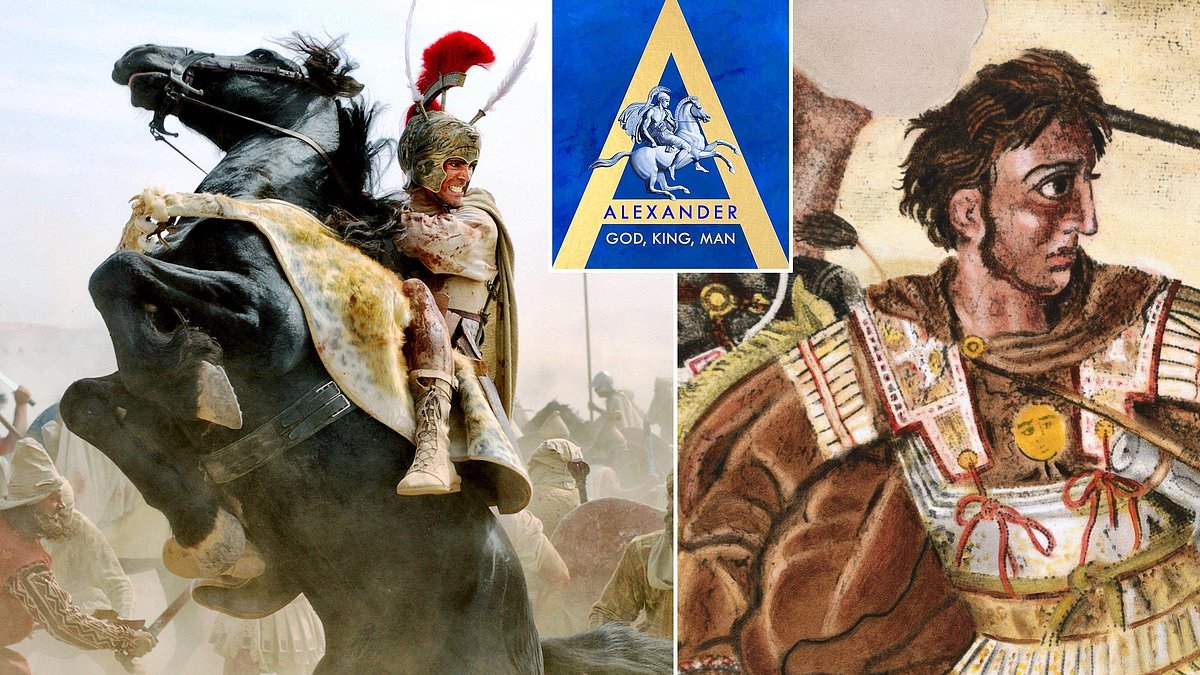
Collin Farrell as Alexander in Alexander
By the time Alexander the Great was 26, he had been deified as a living god in Egypt, crowned King of the Universe in Babylon and filled his treasury with more gold and loot than any ruler had ever dreamed of.
The cities he founded became centres of enlightenment, populated by people sharing ideas from all corners of the known world. On the other hand, 1 per cent of the global population would die as a direct result of his military campaigning, often in hideously cruel ways. So was he a psychopathic ruler who delighted in endless slaughter, or a hero worthy of his epitaph, the Great?
In this staggeringly good biography, Edmund Richardson reveals in riveting and sumptuous detail the real Alexander, the man behind the legend. Richardson has drawn on new sources from recent archeological discoveries, adding a real freshness to this millennia old story.
When he was 20, Alexander inherited a tumbledown kingdom, a fractured military and a mountain of debts. None of the Macedonian army thought that this nervy, beardless king would amount to anything more than a spoilt irrelevance in dire need of a swift assassination.
While he may have been anxious and temperamental, Alexander was certainly no fool, having been tutored by Aristotle, who said Alexander, ‘taught him how to live’.
As king, one of his earliest realisations was that ‘fear, not love, is what would keep him on the throne’.
His father, Philip of Macedon, had been a terror in his own way. Once, after an argument, he nearly ran Alexander through with a sword, only failing because he was so drunk he fell flat on his face.
His mother, Olympias, worshipped the snake cult of Dionysus and would ‘turn up to celebrations with monstrous tame serpents’ that ‘would twist and slither around the women’s wands and wreaths’, horrifying anyone unlucky enough to sit next to her.
Alexander the Great at the Battle of Issus - painting located in Pompeii, Italy
Philip had failed to enrich his kingdom and was eventually killed by one of his own bodyguards. If Alexander valued his life, he was going to have to make the Macedonians rich, and do it fast.
Like every ancient ruler, he knew that the best way to get money was to take it from someone who already had it. Soon, the Macedonian state was to transform into a ‘predator, looting to survive’. What followed became the greatest military campaign of all time, the effects of which ‘would transform the world: from the stars in the sky to the words on this page’.
Almost immediately after Alexander’s accession he captured and annihilated the city of Thebes, leaving only one house standing.
T hey had rebelled against Macedonian rule, and he had responded by butchering the population, including the women and children. This killing spree, combined with the loot he took from the Thebans, asserted his power to his own people, and the rest of Greece – but it wasn’t until the Battle of Issus that Alexander cemented his image as the greatest leader of all time.
The ‘Great King’ of Persia, Darius III, was the wealthiest, most powerful ruler in the ancient world. Alexander never could resist a challenge, and defeating Darius would give him riches and power beyond the achievements of any Greek in history. Darius, however, was not in the least worried. His army was almost triple the size of Alexander’s, he thought himself wiser, and he had in his arsenal scythed chariots.
But the Macedonian army was a well-oiled killing machine. Its greatest weapon was the phalanx – a battalion of infantrymen lined up 16 across and 16 deep, with each man carrying a 19ft-long spear, which the first five ranks would lower when advancing into battle.
It must have resembled some sort of terrifying metal hedgehog, and any man trying to attack the phalanx would have found himself having to fight through five layers of spears before reaching any of the infantry, likely torn to ribbons before getting close. When this was allied with Alexander’s tactical genius, Macedonia’s enemies didn’t stand a chance.
A lexander’s genius lay in sensing just when his enemy was at his weakest. He could find the chink in the armour better than anyone. When Alexander started attacking, Darius could only watch on helplessly as his men were mown down: ‘Suddenly the power of Persia, which had looked invincible in the dawn light, was falling too.’
Alexander is available now from the Mail Bookshop
After Issus, empires fell in Alexander’s path like dominoes. His ferocious reputation meant armies wouldn’t even bother trying to fight. Egypt, for instance, capitulated instantly and the Macedonian king was crowned Pharaoh almost as soon as he stepped foot on Egyptian soil.
He expanded his empire deep into the Indus Valley, further than any Greek had ever gone before, decimating populations along the way. The greater his successes, the more unhinged he would become, often slaughtering simply for the sake of it. It’s hardly any wonder that he thought of himself as a god.
‘Sleep and sex,’ Alexander used to tell his friends, ‘are all that really remind me that I’m human.’
There certainly seemed to be an awful lot of the latter. There were innumerable lovers of both genders, not to mention ‘360 of Darius’s former concubines (one for each day of the Persian year)’.
The true love of his life, however, was Hephaestion. His boyhood comrade and lover was by his side for each of his victories. When his Hephaestion died, Alexander’s tenuous grasp on reality seemed finally to snap.
For hours ‘he lay on top of his companion’s body, weeping for him, and refusing to let go. All day and all night, he held Hephaestion. Then he lowered himself on to the floor, curled up and rocked quietly back and forth, his breath heaving. Alexander had finally broken’.
Alexander had gobbled up much of the known world, but happiness seemed to elude him at every turn. After Hephaestion’s death, a cloud seemed to settle over him. What had been the point of it all? Thousands lay dead and he had built a vast empire, but it was proving to be totally unmanageable.
Soon after Hephaestion’s death, Alexander himself would die of typhoid in Babylon, broken-hearted and alone.
He was mummified as a Pharaoh, but ‘even as the Egyptians eviscerated Alexander’s body, his empire was beginning to fragment’. Babylonian records ‘speak of weeping from one end of the land to the other, of armies being slaughtered, of ruins that were never rebuilt, of light and hope fading’. But what he had achieved was truly astounding.
Through his campaigning, he had stitched parts of the world together that had never been connected before, and ideas spread like wildfire. Greek theories started mingling with Hindu philosophy, Babylonian astronomy, Persian architecture. Alexander had reshaped the world.
I really cannot overstate how fabulous this book is. I was cancelling plans, racing home to read about Alexander. Richardson is an uncommonly gifted writer, combining historical detail with a genius for narrative structure, making this biography as entertaining as a good thriller.
Two thousand years ago, the historian Arrian wrote: ‘Perhaps you are wondering why the world needs another book about Alexander.’
As to whether or not we need another one, who can say, but there can be no doubt the world is a better place for having Richardson’s Alexander in it.

Daily Mail


