The people who took Putin to court and won
By YSENDA MAXTONE GRAHAM
Published: | Updated:
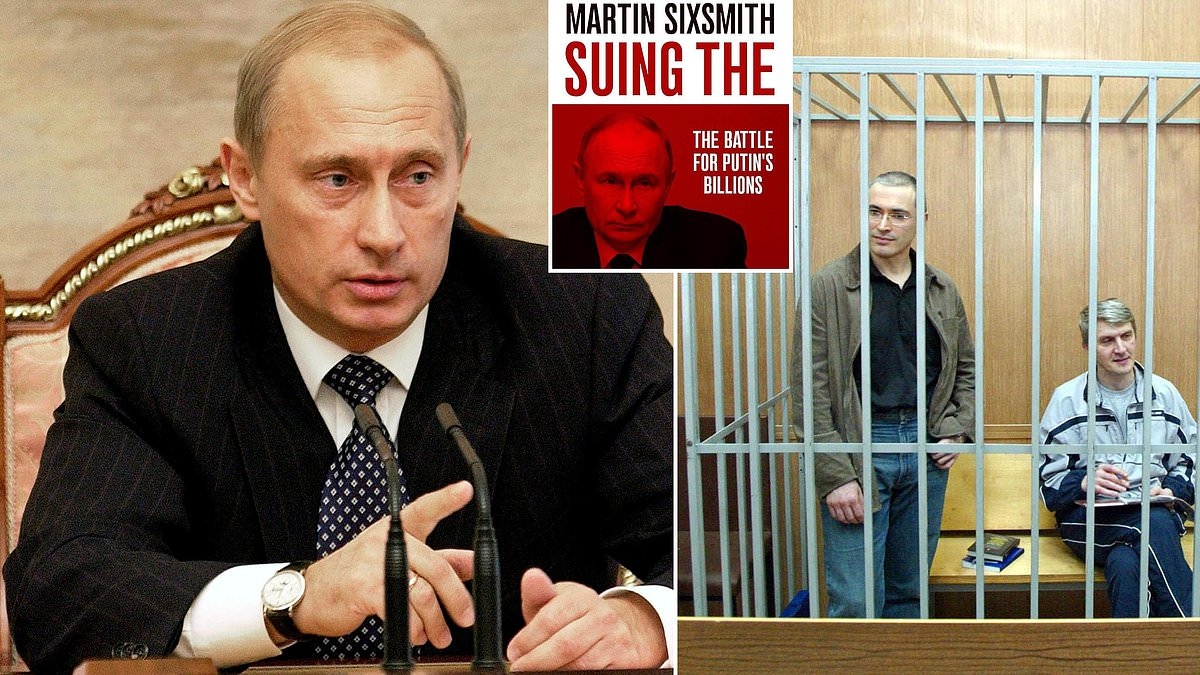
Before his arrest and handcuffing at the moment of touching down on an airstrip in Siberia in October 2003, the Russian businessman and oligarch Mikhail Khodorkovsky had been in the USA, asking the UK-Russia Business Council a key question. Which way would Russia turn, under Vladimir Putin? Would it go towards openness and democracy, or would it ‘continue along the 1,000-year path of authoritarianism’?
He hoped for the former. He’d built up his own oil company, Yukos, into a global business since acquiring it under Boris Yeltsin. He was excited when Yukos shares were accepted for trading on the US stock market. Yukos was so profitable that it accounted for three per cent of the country’s GDP.
Khodorkovsky with Putin in 2002
Khodorkovsky’s hope that the new president would want to encourage this new capitalism was misguided.
Within three years, Khodorkovsky and his colleague Platon Lebedev would be charged with numerous allegations of crookedness and tax evasion.
According to Khodorkovsky, the ten-month trial was rigged: the judges were ‘waiting by the telephone for the Kremlin to ring and dictate their verdict’. Both Khodorkovsky and Lebedev would be found guilty and sentenced to nine years each in a Siberian labour camp.
In this jaw-dropping book, Sixsmith, who was the BBC’s Moscow correspondent during the dissolution of the Soviet Union, tells the story of Putin’s confiscation of Yukos, his persecution of its employees, and how the revenues he accrued from such confiscations allowed the Kremlin to amass a vast national war chest. He also tells of what happened when a team of lawyers poured their expertise into trying to win redress for the company’s shareholders.
Suing the Kremlin is available now from the Mail bookshop
It’s deeply unsettling to read what happened to some of Yukos’s employees in the weeks after Khodorkovsky’s arrest. One female lawyer, a young mother, was arrested at 5am, charged with the theft of $300 million, and sentenced to seven years in a maximum-security jail. She was denied contact with her child. Another lawyer, who suffered from HIV, was thrown into jail and denied treatment unless he testified against Khodorkovsky. The 35-year-old refused and died of Aids aged 39.
Brace yourself for the complicated and long-drawn-out legal battle that ensued. It would take a protracted effort by determined and brave international lawyers eventually to achieve the almost impossible legal feat by which ‘the Claimants’ (known by the initials ‘HVY’) successfully sued the Kremlin at an international tribunal in The Hague.
It wasn’t till 2014 – after six years of Russia’s delay tactics – that the tribunal made its decision. It issued three Final Awards, which found in HVY’s favour. The Kremlin was required to pay back $50 billion to the shareholders.
Not that Putin has voluntarily paid a penny of that money back so far. The only way to claw some of it back has been by seizing Russian assets around the world – not an easy feat. The quest to recoup the money in tiny dribs and drabs is very much ongoing.
But, as one of the arbitrators, Yas Banifatemi, said, ‘Every single penny we can get is worth getting … it’s called international satisfaction.’

Daily Mail