What are my rights while working in extreme heat in Spain?
Spain is enduring its first official heatwave of the summer with many suffering in scorching temperatures, particularly those working outdoors. Here's what the country's labour laws say about working in extreme heat, and if it applies to remote work.
According to the MoMo daily mortality surveillance system, an estimated 27,564 people died from causes linked to high temperatures between 2015 and 2025. The worst year was in 2022 with 4,789 deaths.
Some of these people were those who had died on the job, such as a street cleaner in Madrid who suffered heat stroke in temperatures over 40C in 2022.
Working in sweltering conditions is not only very difficult but can be dangerous too, so what are your rights as an employee and what does Spanish law say about working in extreme temperatures?
Working indoors
In indoor workspaces, where people are seated such as in an office, the law states that the temperature must be between 17C and 27C.
And in those indoor workspaces where light work is carried out and people are moving around most of the time, it must be between 14C and 25C.
That means that legislation on working in extreme temperatures applies to both hot and cold weather.
The law also states that the humidity should be between 30 and 70 percent, except in places where there is a risk of static electricity, in which case the minimum should be 50 percent.
Spain's Royal Decree 486/1997 annex V also states that there should be fresh water available in the workplace for all employees.
As the law was created in 1997, there are no such temperature limits set for remote workers or the self-employed (autónomos) who may not be able to keep their home office below 27C if they don’t have air-conditioning.
READ ALSO: Ceiling fan vs air con in Spain: Which offers the better price-coolness ratio?
Working outdoors
It’s usually those who are working outdoors who are most affected by the heat, but surprisingly there's not a specific legal maximum temperature in Spain for working outdoors.
That doesn't mean workers don't have rights though and there isn't legal protection.
What does the law say?
Royal Decree 486/1997 states that "when work is carried out outdoors and in workplaces that, due to the activity carried out, cannot be closed, appropriate measures must be taken to protect workers from any risk related to adverse weather phenomena, including extreme temperatures".
It goes on to add the the worker can be "prohibited from carrying out certain tasks during the hours of the day when adverse weather phenomena occur, in those cases where the proper protection of the worker cannot be guaranteed in any other way".
Instead of there being one maximum temperature where everyone is allowed to stop work conditions are linked to Spain's State Meteorological Agency's (Aemet) alert system, where the thresholds very by region.
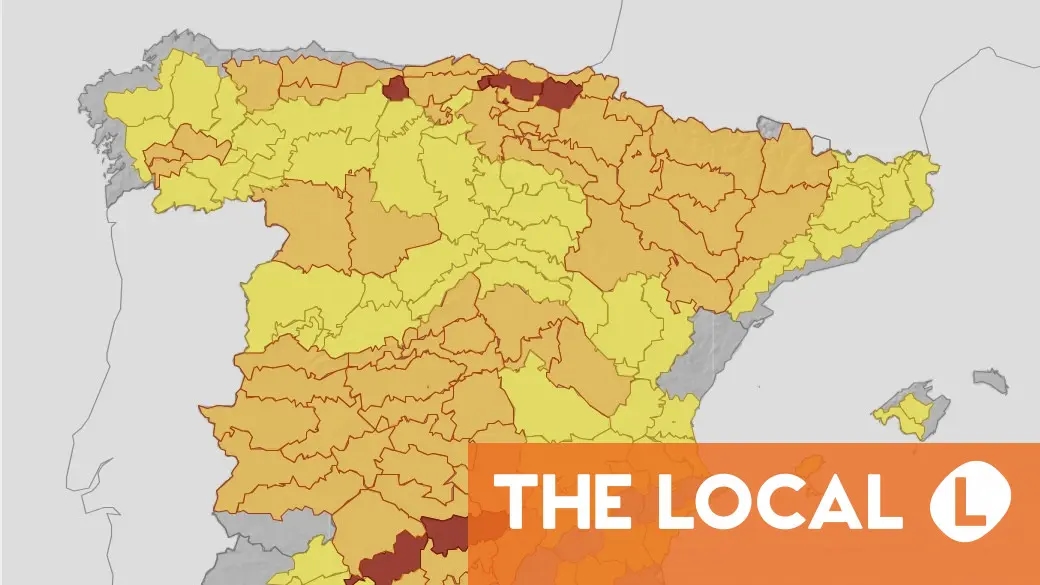
When Aemet issues an orange or red weather alert for heat in your area, per Royal Decree Law 4/2023 it is mandatory to adapt working conditions, including reducing or modifying working hours if necessary.
Article 21 of Spain's Law on Prevention of Occupational Risks also states that "The worker will have the right to interrupt their activity and leave the workplace, if necessary, if they consider that said activity entails a serious and imminent risk to life or health".
The law also states that companies who are employing people to work outside must provide free equipment to protect them from the sun such as a hat, sunglasses and sunscreen.
How the floods in Valencia changed the Workers' Statute
After Valencia's deadly storm and flooding in 2024, changes to the Workers' Statute were made to include paid leave of up to four days "when there is a situation of serious and imminent risk, including those derived from a catastrophe or adverse weather phenomenon". This situation could apply to heat not just storms.
The law also allows companies to suspend an employee's contract during the emergency period or approve a reduction in their working hours "until the extreme circumstances that caused this situation disappear".
What's new in 2026?
More recently on April 28th, 2026, Spain formalised its adherence to the ILO Convention that recognises the right to a "safe and healthy working environment".
Under this, trade unions and hospitality employers' associations Hostelería de España signed an agreement which meant that establishments to close their terraces during extreme heat weather alerts in order to protect their staff.
Essentially it's a modification of the framework of the State Labour Agreement for the Hospitality Industry and means that whebn official weather alerts are activated by Aemet , especially at orange or red levels due to heatwaves, companies must carry out a risk assessment to determine if it's possible to maintain outdoor activity without compromising the health of their workers.
Each regional government is able tweak the new regulation to meet their needs and differences in temperatures, depending on where they're located in the country.
The agreement showed that those workers at the highest risk of extreme temperatures are those who serve on terraces, work in kitchens, and carry out outdoor delivery services.
If the assessment concludes that safe working conditions cannot be guaranteed, the company will be required to reduce working hours, temporarily suspend operations during peak risk times or close the terraces completely.
Regional differences
There may be some regional differences too. In 2022 after the death of the street cleaner in Madrid, several city employers, as well as workers' unions agreed upon a plan of action for outdoor workers during a heatwave.
It means that if temperatures rise above 36C a yellow warning will be issued and shifts will change to the evening when it's cooler. Air-conditioned vehicles are also used and those who don't have air-conditioned vehicles have 10-minute breaks every hour to cool down.
If temperatures rise above 39C, an orange alert is issued meaning those who carry out manual labour outdoors will have shifts cancelled or changed to later and workers must go in pairs, never alone.
What can I do if I feel it's too hot to work and it's affecting my health?
If you're working indoors, it should be easy enough to check what the temperature is and ask your employers to increase the power of the air conditioner, thus cooling the air to less than 27C.
If you are a remote worker, you should check how hot your home office or lounge is and inform your boss if you feel it's over the limit and it's affecting the way you work. If you don't have an air conditioner or an adequate fan at home or can't afford one, it may be a reasonable request for your company to be able to provide a fan for you to work at home.
For those working outside, it's important to speak up if you feel unwell and let your employer know if you feel that the extreme heat is putting your health at risk. Make sure you are provided with all the necessary equipment and are given enough breaks with plenty of water and shade.
Recently, the Minister of Labour, Yolanda Díaz called on companies to take extra precautions against the high temperatures and prioritise the health of their employees.
“If necessary, we have weather-related leave available for all workers for up to four days; we should provide hydration, but if these measures are insufficient, workers have access to weather-related leave. No one should take risks,” she stated.
Become a member or log in to continue reading

thelocal