
There’s Already a Far More Damning Account of Jeffrey Epstein’s Crimes Than Anything in the New Files

Late last week, after urging from both political supporters and detractors and a congressional mandate, Donald Trump’s administration at long last published more of the Epstein files. The documents expand on what we already knew: Jeffrey Epstein, a financier of extravagant wealth with connections to some of the world’s most powerful entrepreneurs and politicians, was abusing untold numbers of teenage girls and young women. Yet Trump’s Department of Justice has heavily redacted the documents, purportedly to protect victims from having their faces published but notably also shielding many adult men named or photographed with underage girls. There are a few new pictures of Epstein with famous men, but none prove that any of them were or are abusers: There’s Bill Clinton in a pool with Ghislaine Maxwell, Epstein, and a faceless girl, or another of Michael Jackson and Diana Ross posing with blacked-out children who turned out to be Ross’ own kids. The pictures are curious but not clarifying.
The rush to understand more about Epstein’s criminal network—and the president’s possible involvement in or knowledge of it—has been breathless and breakneck. The latest documents are disappointing, and the DOJ seems unlikely to give the public a full, honest recounting of what’s in the files, at least not during this particular administration.
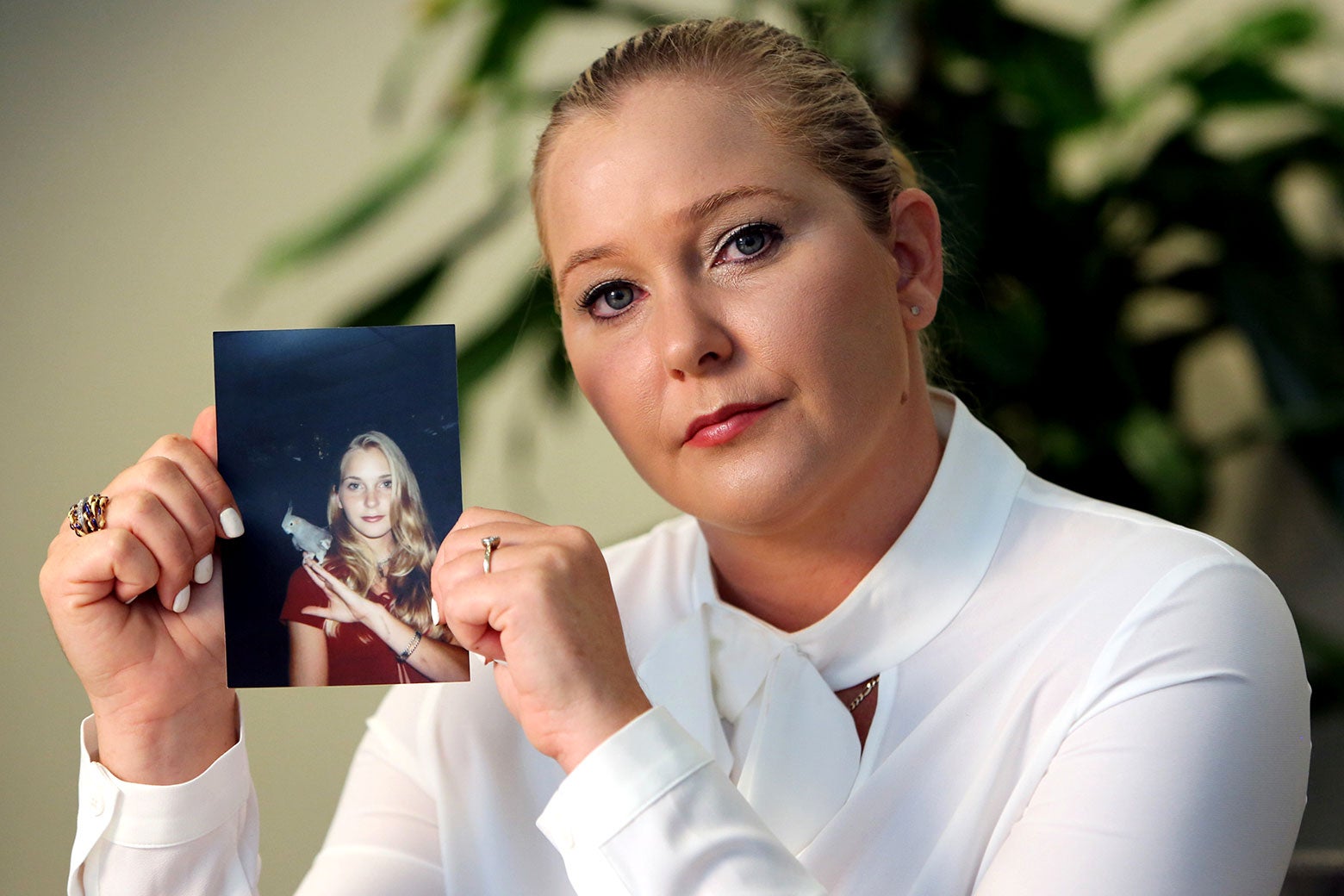
But a few weeks ago, a more compelling story of Epstein’s brutality was released. Virginia Roberts Giuffre’s memoir, Nobody’s Girl, came out seven months after she killed herself in her home in Australia. In the book, a collaboration with journalist Amy Wallace, Giuffre tracks her life, from being sexually and physically abused by her father and his friend, abandoned by her entire family throughout her teen years, and eventually trafficked by multiple men before landing a job at Mar-a-Lago and getting recruited by Maxwell herself. She’s now perhaps best known as the young woman standing in a photograph next to former Prince Andrew, who she said abused her when she was 17 years old. (Andrew has never admitted to abusing Giuffre but eventually, through a settlement, offered his “regrets” to her.)
If you’re seeking clarity of closure around Epstein, or at least a better understanding of what he did to all those girls, Nobody’s Girl is far better source material than anything the courts could offer. Details are sordid and devastating and nuanced: Epstein was proud and defiant about the way he abused girls, who were restricted from eating, forced to have unprotected sex, and eventually abandoned as they spiraled into addiction and self-harm. He believed that it was his right to brutalize children, that these girls were inherently designed for his physical and emotional harm. It’s a fallacy to believe that court documents could ever be gratifying in this case. Nobody’s Girl is the only document that can begin to capture what Epstein did, and how those cruelties ripple through our world even still.
Because it was written in collaboration with Wallace, a journalist, Nobody’s Girl reads with the full context of Giuffre’s life, but also of Epstein’s power. Giuffre’s inclination toward Epstein is explained through the abuse she suffered by her father and how few adults she had to rely on. Occasionally, she is shown some kindness—like by a chef who made her pizza after her encounters, even as Epstein kept her on a strict diet—but there are few escapes. She has no education, job, or place to stay. Giuffre’s only eventual opportunity, as she writes in Nobody’s Girl, comes when Epstein and Maxwell asked her to have their baby. She asks in return if they’ll send her to Thailand so she could finally get the massage training she was originally promised by them as a teen. After she goes on her trip, she meets another man and marries him immediately. This could be a nice story, but as Wallace writes in her preface, Giuffre alleged that her husband abused her throughout their marriage. They had been separated by the time she killed herself in April.
Giuffre told herself what most abuse victims tell themselves when it starts: “Just get the icky part over with so the good parts of life can go on.” That modality is what kept her safe, but it’s also what kept her in a cycle of abuse. Court filings often fail to describe the fullness of a victim’s assault; the clinical nature of that kind of paperwork gives a grim and limited snapshot of a lifetime of harm. There’s only so much context that can be provided in legalese.
The intense focus on the Epstein files is, in many cases, well-intentioned. We all want to know if there are powerful pedophiles and ephebophiles in our midst. But it has also become a celebrity circus, the emphasis less on what happened to these girls and women and more on which recognizable names we can find in the documents. Giuffre has already told us much of what happened, and we can put the clues together.
There’s a scene in Nobody’s Girl in which Giuffre describes being violently raped orally, vaginally, and anally by an unspecified prime minister. She writes that she can’t name him out of fear of personal reprisals; she had already been harassed within an inch of her life, and the trials and depositions had taken a toll on her health and her spirit. Knowing the identity of the man is important; he committed a crime, one of the worst types, and is deserving of shame and punishment. (In past court filings, Giuffre said she was raped by Israeli Prime Minister Ehud Barak, but it’s unclear if the rape she discusses in the book is by the same politician; Barak has denied the charge.) But knowing who he is wouldn’t give Giuffre’s rape new value or meaning. It wouldn’t make it more or less believable. In the urgency to find out the who of the perpetrators, there’s a flattening of who was harmed in the first place.
We may never know everything that happened. Giuffre died without getting closure on so much of her own life, from Epstein associates who refused to tell the truth about what they saw, to her own father, who allegedly later took payments from Epstein. Our court system is barely designed for justice, never mind closure.
The full Epstein files should undoubtedly be released. It’s what Giuffre would have wanted; as she writes in the book, she spent the second half of her life fighting for justice for what happened to her in the first. But the legal documentation around her case and cases like hers was always going to be secondary. The court system can never fully describe what Epstein did. At least Giuffre did most of the work for us, while she could.

Slate