This is unbearable. I'm dizzy, disorientated, a kilogram lighter and my legs are like lead. How hard will it be playing in 'dangerous' 40°C heat at the World Cup? I found out the hard way - now I know why experts think players won't even last a half
Published: | Updated:
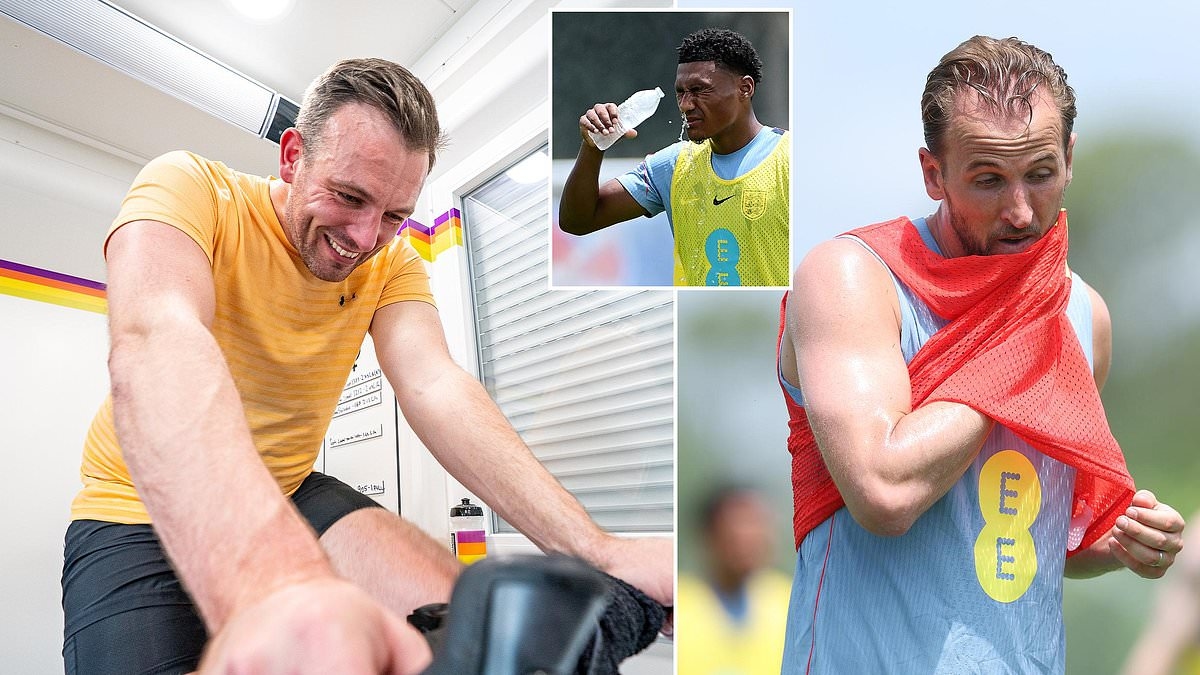
Rivers of sweat pour from my forehead and other, thankfully, more well-hidden areas. My legs feel like they’re weighed down with lead as I battle against the oppressive conditions.
It hasn’t taken me long to be both physically and mentally cooked.
I’m reaching the end of a gruelling 50-minute exercise stint during which the average temperature has been 39.8°C and the humidity 46 per cent – just the sort of conditions England’s players will face at the World Cup.
My stint in an artificial heat chamber is designed to provide an insight into what awaits Thomas Tuchel’s squad in the coming weeks and, all I can say as a fan is... I hope Harry Kane and Co fare a lot better than I did.
Like any England supporter, I’ve had significant frustrations watching my country compete at football’s major tournaments over the years. The penalty heartbreak. The near misses. The players who look like they're running through treacle. The England shirt weighing heavy. The unbearable goalless draw with Algeria at the 2010 World Cup.
This year, however, I will have second thoughts before ranting at the television, particularly when it comes to criticising the pace at which England play. That’s because ahead of the 2026 tournament in the USA, Mexico and Canada, I was given a small yet painful experience of what the World Cup will bring for England and the other competing nations.
Rivers of sweat pour from my forehead and other, thankfully, more well-hidden areas. My legs feel like they’re weighed down with lead as I battle against the oppressive conditions
I’m doing a gruelling 50-minute stint in an average temperature of 39.8°C and humidity of 46 per cent – just the sort of conditions England’s players will face at the World Cup
It is set to be a test like no other in history, with three host countries and more teams (48) and matches (104, across 39 days) than ever before. But arguably the biggest challenge will be the weather.
Four years on from a World Cup being moved specifically to avoid a dangerously hot summer, experts suggest a quarter of matches will be played in heat above 26°C. In venues such as Miami, Dallas and Kansas City – where Tuchel’s men will be based for training – temperatures could touch 40°C.
High humidity will also be a factor, as will altitude in Mexico City and Guadalajara – the first of which is more than 2,200 metres above sea level. There is also a high risk of thunderstorms, wildfires and poor air quality – all things that could affect the on-field action.
As I can attest, it is set to test the globe’s best footballers to their absolute limits.
The sign on the wall of the chamber says everything about what I can expect. It reads: ‘The heat is on.’ Chris Harris, a sports scientist with Precision Fuel & Hydration, based just outside Bournemouth, explains what’s coming my way as I prepare to enter the company’s state-of-the-art equipment.
‘It will be like when you get off the plane on holiday – only hotter!,’ Harris says. ‘But it will still be about two degrees colder than the highest temperatures some of the World Cup games will be played at.’
The scientists at Precision specialise in hydration, sweat analysis and recovery and I am their latest guinea pig, following in the footsteps of some esteemed company.
Anthony Joshua, LeBron James, the Lionesses, a host of Premier League sides and top endurance athletes such as Tour de France stage winner Victor Campenaerts have all worked with the organisation over the years with one thing in mind – to maximise their performance. Now, I am next, though my aim is slightly different.
In venues such as Miami, Dallas and Kansas City – where Tuchel’s men will be based for training – temperatures could touch 40°C
High humidity will also be a factor, as will altitude in Mexico City and Guadalajara – the first of which is more than 2,200 metres above sea level
It doesn’t take long for the sweating to begin, despite the fact I am hardly pedal to the floor and not doing the sort of short, sharp sprints required at international football’s highest level
It is more about survival and to get a small taste of what the World Cup will entail for the players in terms of physical endurance. At this juncture, I must point out that while still relatively physically fit, I am closer to 40 than 30 (that’s painful to write) and no elite athlete.
I never had Declan Rice’s box-to-box energy but if I had, it would have left me long ago. I am well aware there is absolutely no direct comparison in terms of physical fitness between me and England stars such as Kane and Rice. But I am intrigued, as well as nervous, about what’s to come.
Before I enter the chamber, I am hooked up to an electronic gadget on my forearm that, although I am sedentary, tricks my body into thinking it is sweating. I am told the analysis shows I am above average in terms of the amount of sodium lost per litre of sweat and as such, need to hydrate more to stay in peak (ahem) condition.
‘You’re going to get a snapshot of how your body is going to react in the heat and how you’d perform if you were a player at the World Cup,’ Harris tells me.
The time is now. For pretty much all of the next hour, I am tasked with cycling or running in the chamber where the heat is close to unbearable. I’m not sure I ever really acclimatise to the stark temperature differential, but I have no choice other than to begin exercising. I try to regulate my breathing, but the air is thin. It feels like there is no oxygen to suck in.
It doesn’t take long for the sweating to begin, despite the fact I am hardly pedal to the floor and not doing the sort of short, sharp sprints required at international football’s highest level. I am checked on regularly and asked to describe how I’m feeling using a sliding numerical scale in terms of tiredness and temperature. My pace is medium at absolute best.
As I struggle and sip on the rehydration drink Harris has given me, I wonder how on earth England's players will be able to cover every blade of grass at the World Cup, even with the water breaks midway through each half to allow players to recover (and advertisers to plug the gaps in play).
England and their rivals will have left no stone unturned in terms of their physical preparation. Tuchel’s side are gearing up for their campaign with a warm-weather training camp and matches in Florida at the start of June. And they'll need it, to cope with the host cities – the group stage venues in Arlington, Foxborough and East Rutherford have average June highs of 32, 25 and 30°C respectively.
England and their rivals will have left no stone unturned in terms of their physical preparation. Tuchel’s side are gearing up with a warm-weather camp in Florida
I am checked on regularly and asked to describe how I’m feeling using a sliding numerical scale in terms of tiredness and temperature. My pace is medium at absolute best
As I struggle and sip on the rehydration drink Harris has given me, I wonder how on earth players such as Declan Rice will be able to cover every blade of grass at the World Cup
But even their pre-tournament boot camp might not be enough for England. Leading scientists have already warned FIFA their safety measures are ‘inadequate’ and could put players at risk. As my legs get heavier and heavier and my pace slows to snail-like, I begin to think the boffins have a point.
I am thankful – not to mention totally whacked – when my time in the chamber is halted. I emerge, jelly-legged, to receive my test results.
The heat caused me to lose over a litre of sweat, roughly equating to a kilogram in weight. At the World Cup, players will – clearly – lose far more than that over the course of 90 minutes.
It is when two or three per cent of body mass is lost that performance starts to rapidly decline. Rehydration, of course, will be crucial, and Scotland, Algeria and Austria will all be using Precision’s products over the course of the tournament.
‘We have been to most Premier League clubs over the last 10 years,’ Harris tells me. ‘We’re the only company in the world that does this type of testing. Most elite players are of a similar fitness level. The key to success at the World Cup will be how to maintain that level for as long as possible. The truth is it would be very difficult for you to keep the pace required for even one half of football. It’s going to be very tough on the players.’
Chris reminds me that with the World Cup being played in three different countries, competing teams will encounter huge swings in conditions. There could be as much as a 20°C difference between the likes of Miami and other, colder host cities.
To take my mind off the pain, I wonder if the likes of Rice, who has been superb for Arsenal over the course of a successful but long domestic season and will have less time to acclimatise as he and his Arsenal team-mates are late arrivals after the Champions League final, has enough juice left in the tank.
My experience of the heat only serves to reinforce in my mind that this World Cup could yet border on farcical, even with things like air-conditioned stadiums and drinks breaks in play. I leave and spend the next 12 hours mostly sleeping, rehydrating and nursing a severe headache. A little over 24 hours later, I start to regather some energy and reflect further.
My experience of the heat only serves to reinforce in my mind that this World Cup could yet border on farcical, even with things like air-conditioned stadiums and drinks breaks in play
So, when I see England passing the ball around at the back over the course of the next month to retain possession and reduce tiredness levels, I will truly understand why
It showed me that to emulate the country’s heroes of 1966, England’s class of 2026 will have to not only be at the top of their game, but also in peak condition.
The impact of the heat will no doubt influence not only physical performance, but also mental decision-making. I simply could not have done 90 minutes in that chamber and left it feeling dizzy and disoriented.
So, when I see England passing the ball around at the back over the course of the next month to retain possession and reduce tiredness levels, I will truly understand why. End-to-end, high-octane football will simply not be possible in the games played in warmer climates.
Thankfully, I’ll be on the sofa.
For more information on Precision Fuel & Hydration visit https://www.precisionhydration.com/

Daily Mail