College football's top position groups in 2026: Ranking the nation's 10 most-talented units

Across college football, roster building has shifted into overdrive. High school recruiting at the top end is more refined, the transfer portal has become a shortcut to immediate impact and returning veterans are choosing development over early NFL exits at rates that reshape entire depth charts.
The result is a handful of programs stacking blue-chip talent at the same position until it becomes a matchup problem for everyone else. That's the lens for this list: not just production, but pure talent density. Who has the most NFL bodies in one room? Who can rotate four or five players without a drop-off? Who forces opponents to scheme differently just to survive four quarters?
From wideout groups loaded with former five-stars to defensive lines that resemble Sunday rosters, the gap between good and great is defined by depth, explosiveness and versatility. And in 2026, several programs have separated themselves from the pack, with position groups that don't just win matchups -- they tilt entire games.
College football's 10 most complete rosters: Georgia, Ohio State boast elite depth ahead of 2026 season
Brad Crawford
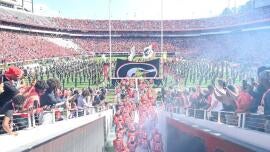
The next step is ranking them. From wide receiver arsenals built to overwhelm secondaries, to defensive fronts that collapse pockets on command, college football's most talented units are no longer singular stars surrounded by hope -- they're waves of elite athletes arriving in succession.
These are the 10 position groups that define college football's talent ceiling heading into the 2026 season.
1. Ohio State wide receiversOhio State's reputation as "Wide Receiver U" isn't slowing down anytime soon, and the Buckeyes enter the 2026 season with what is once again college football's most talented pass-catching corps. Despite losing No. 4 overall pick Carnell Tate, this group is loaded, and it starts with Jeremiah Smith, the sport's premier pass-catcher and legitimate Heisman Trophy candidate heading into his junior season.
Defenses have spent two years trying to find answers for Smith's blend of size, explosiveness and elite ball skills, but they've come up empty. After posting more than 2,500 receiving yards and 27 touchdowns during his first two seasons in Columbus, Smith remains the standard at the position nationally.
What separates Ohio State from everyone else, however, is what surrounds him. Senior Brandon Inniss is poised for an impactful campaign as he steps into a featured role and gives the Buckeyes a veteran playmaker capable of thriving underneath while creating chunk plays after the catch.
Then comes the next wave. Five-star freshman Chris Henry Jr. arrived with enormous expectations and has already generated buzz as Ohio State's next star on the perimeter, along with fellow first-year player Brock Boyd. Henry, at 6-foot-5, offers another matchup nightmare opposite Smith. Transfer addition Devin McCuin brings proven speed and experience.
2. Oregon defensive lineIf you're searching for the biggest strength on Oregon's roster, start in the trenches. The Ducks bring back a veteran-heavy defensive line with potential early-rounders across the board. All four starters -- A'Mauri Washington, Bear Alexander, Matayo Uiagalelei and Teitum Tuioti -- bypassed professional opportunities and chose unfinished business in Eugene. In an era where elite players routinely leave early for the NFL, Oregon convinced its entire starting front to return for another run at a national championship.
That level of continuity is almost unheard of in modern college football.
Washington serves as the anchor inside, a disruptive force who commands double teams and creates opportunities for everyone around him. Alexander gives Oregon another powerful interior presence, forming one of the country's most physical defensive tackle pairings. Off the edge, Uiagalelei and Tuioti provide relentless pressure. Tuioti led Oregon in sacks and tackles for loss last season.
What makes this group truly dominant isn't just star power -- it's experience. These players have logged hundreds of snaps together in Dan Lanning's system and understand how to play off one another. Oregon doesn't need to rely on potential. The Ducks already know exactly what they're getting from a veteran unit loaded with all-conference talent.
And the depth behind them isn't lacking either. Former five-star Elijah Rushing is pushing for a larger role, while North Carolina transfer D'Andre Robinson contributed 39 tackles during his only season with the Tar Heels. Jerome Simmons was Oregon's first portal commitment this cycle after playing at Louisiana-Monroe and fills a rotational role.
Championship teams are built up front. Oregon's veteran-heavy defensive line gives the Ducks a chance to control games, overwhelm opposing quarterbacks and carry one of the nation's most complete defenses into the College Football Playoff race.
3. Notre Dame secondaryThe Fighting Irish have produced plenty of elite secondaries over the years, but the back end of their defense this season has a chance to top them all. The primary factors are experience and star power. Marcus Freeman returns four proven starters in the defensive backfield, led by Leonard Moore, who enters the season as the nation's top cornerback after a dominant 2025 campaign that included five interceptions and national awards recognition.
What's scary for opposing offenses is that Moore isn't carrying the load alone. Christian Gray returns as a multi-year starter with NFL talent and positional versatility, giving Notre Dame another lockdown defender capable of matching up with elite receivers. Gray played the last two seasons at cornerback, but is likely moving to nickel as the fifth starter this fall. Transfer Jayden Sanders repped there during the spring as well, along with Dallas Golden.
At safety, Adon Shuler and Tae Johnson form one of the country's most complete tandems. Shuler brings veteran leadership and playmaking ability, while Johnson emerged as one of college football's breakout defensive backs last season.
Much like Ohio State's wideout room and Oregon's effort along the defensive line, Notre Dame's depth is elite. This program has developed a reputation for stockpiling defensive back talent, and several former blue-chip recruits are waiting in the wings behind the starters. The addition of cornerback transfer DJ McKinney from Colorado only adds more competition and athleticism to an already loaded room. McKinney collected four interceptions in two years with the Buffaloes after spending the first two seasons of his college career at Oklahoma State under then-coach Mike Gundy.
4. Texas wide receiversSteve Sarkisian's team is built to win it all, largely due to the investment made in the Longhorns' wideout group. The Longhorns landed Cam Coleman, the top receiver available in the transfer portal this cycle, who had a who's who list of offers but opted to become the centerpiece of the Texas offense. Coleman arrives in Austin after producing 13 touchdowns during two seasons at Auburn and gives Arch Manning another NFL-caliber target on the perimeter.
Few teams can match a one-two punch as dangerous as Coleman and Ryan Wingo on the outside. Wingo, a former five-star recruit, led Texas in receiving yards last season and should soften the blow of Texas losing Parker Livingstone to Oklahoma. Alongside Wingo, Emmett Mosley V emerged as a dependable weapon last season, averaging nearly 15 yards per catch, while former blue-chip recruits Kaliq Lockett and Ryan Niblett provide Texas with an abundance of talent waiting for larger roles. Sarkisian can rotate fresh bodies without sacrificing production, a luxury few contenders possess.
And of course, there's the budding superstar who's throwing them the football. With Arch Manning entering another season as the face of the program, Texas has a quarterback capable of maximizing every matchup. That's partly why many evaluators consider Texas' pass-catching corps the SEC's best and chart the Longhorns as a national championship favorite.
The Hoosiers are deeper up front than they were a year ago during their run to the program's first national championship, but spring injuries limited what Curt Cignetti could grade from what's expected to be an eight-or-so-man rotation this fall. That said, on paper, this group should be able to move the opposition off the ball and again generate explosion from a quartet of newcomers at the skill positions, including former TCU quarterback Josh Hoover.
What makes this offensive group especially dangerous is its versatility. Indiana isn't relying on one dominant player to carry the load. Instead, the Hoosiers feature five veteran linemen who understand leverage, assignments and how to function within Cignetti's system. That collective experience should overwhelm most of the fronts the Hoosiers will face in the Big Ten. Left tackle Carter Smith is an anchor, along with Wisconsin transfer Joe Brunner, who can move people at either of the guard spots. Drew Evans, Bray Lynch and right tackle Adedamola Ajani are the others in the starting lineup coming out of spring.
For a program with legitimate CFP aspirations, the offensive line remains the foundation.
6. Ole Miss backfieldIt's cheating a bit to put quarterback Trinidad Chambliss and running back Kewan Lacy in the same position group, but for this exercise, the inclusion of a backfield designation is necessary. The returning firepower in Oxford from those two All-American candidates can't be matched nationally after the duo combined for 54 touchdowns last fall, as the Rebels took out Tulane and Georgia in the CFP before almost doing the same to Miami in the semifinals.
Everything begins with Lacy, a player many evaluators consider RB1 in the SEC over Missouri's Ahmad Hardy. After rushing for more than 1,400 yards and 20-plus touchdowns during an All-SEC campaign, Lacy elected to return to the Rebels instead of pursuing the NFL or an opportunity with Lane Kiffin at LSU, giving this offense a true game-changer capable of scoring from anywhere on the field. His vision, acceleration and ability to create yards after contact make him one of the sport's most complete offensive weapons.
The quarterback position adds another layer of explosiveness. Chambliss gives Ole Miss something every defensive coordinator fears: unpredictability. The veteran quarterback stresses defenses before the snap and punishes them after it. Chambliss has the arm talent to attack every level of the field, but it's his mobility that makes him especially deadly. When protection breaks down, he's capable of extending plays and turning would-be sacks into chunk gains.
This Ole Miss offensive scheme, even under new coordinator John David Baker, is built around creating space, and Chambliss thrives in it. He's decisive with the football, hard to corral on designed quarterback runs and possesses the acceleration to make defenders miss in the open field. Defenses can account for him with spies and still struggle to contain him for four quarters.
Ole Miss can win with power, speed, misdirection or tempo. There are multiple weapons in the backfield, and as long as Chambliss and Lacy stay healthy, the Rebels should be able to keep up with any team on the schedule.
7. Georgia linebackersYear after year, Georgia churns out elite production from its linebackers, and the formula remains unchanged under Kirby Smart. High-end recruiting, NFL-level development and a defensive system that demands versatility continue to make this group in Athens the gold standard at the position.
Even after losing standout CJ Allen to the NFL, Georgia returns with proven talent and emerging stars. Raylen Wilson's decision to return gives the Bulldogs an experienced leader in the middle of the defense. Wilson has been battle-tested in big games, understands every aspect of Glenn Schumann's scheme and enters the season as productive as they come at the position. His instincts, sideline-to-sideline range and physicality set the tone for Georgia's front seven.
Chris Cole and Justin Williams were among the nation's most coveted recruits and have developed exactly the way Georgia hoped. Both possess the speed and athleticism necessary to thrive in modern defenses while maintaining the physical edge required to stop the run. Add in rising talents like Zayden Walker and a wave of highly-rated first- or second-year defenders, and the Bulldogs have quality depth.
That's been the secret to Georgia's sustained dominance. The Bulldogs don't just develop one standout linebacker every few years -- they stack future NFL players at the position and allow them to learn within one of the nation's most demanding defensive cultures.
And remember the name Chase Linton, who's projected to be a breakout player this fall from program insiders. He'll share snaps at the Jack position with Quintavius Johnson. The original plan was for Auburn transfer Amaris Williams to start there, but a knee injury sustained during spring camp will likely keep him out for the entire upcoming campaign.
8. Miami backfieldThe Hurricanes don't just have talent -- they have game-breakers at multiple positions capable of turning routine plays into touchdowns, and they spent big money this offseason to ensure another deep advancement in the postseason.
The most notable newcomer is former Duke quarterback Darian Mensah, one of the most coveted transfers of the 2026 cycle. After throwing for nearly 4,000 yards and 34 touchdowns while leading the Blue Devils to an ACC championship, Mensah arrives in Coral Gables as the latest star quarterback to take control of Mario Cristobal's offense. His ability to stretch the field vertically, make off-schedule plays and punish defenses with quick decisions gives Miami another dynamic centerpiece under center for the third consecutive season.
Miami believes Mensah's blend of the aggressiveness Cam Ward brought to the offense and the efficiency Carson Beck provided during the Hurricanes' playoff run will pay off immediately. Behind him is veteran running back Mark Fletcher Jr., one of the ACC's most physical runners. Fletcher combines power, balance and surprising burst for a player his size. He consistently turns short gains into chunk plays and gives Miami a dependable option when defenses sell out to stop the pass.
The result is a backfield that can beat opponents in multiple ways. Mensah can carve defenses up through the air, Fletcher can wear them down on the ground, and both are capable of producing game-changing moments when the Hurricanes need them most. For a program with national championship hopes, that's a potentially lethal dose for opposing defenses. This Miami backfield could serve as the engine behind another playoff push in a few months.
What elevates this unit from good to potentially elite is the influx of portal talent to combine with future first-rounders Trevor Goosby (left tackle) and Brandon Baker (right guard). Texas addressed depth concerns and added proven players expected to secure starting jobs immediately. Those additions not only improve the first five but create competition throughout the room, something every championship contender needs over the course of a long season.
Western Kentucky transfer Laurence Seymore successfully got his waiver to play this season and is expected to start at left guard. However, Jaydon Chatman took advantage of his opportunity during spring practice with Seymore away and impressed the Texas staff. Former Wake Forest starter Melvin Siani is holding down the right tackle spot after starting every game last fall for the Demon Deacons. Insiders believe the center job is Connor Robertson's to lose.
The versatility of this offensive line group at Texas also stands out. The Longhorns have linemen capable of excelling in pass protection while still generating movement in the running game. That's critical in Sarkisian's offense, which demands athleticism, communication and the ability to execute in space. Devin Coleman and Andre Cojoe are critical depth pieces behind the aforementioned five expected starters.
10. Alabama secondaryOne defining trait that separates Alabama's secondary from most of college football: pure speed. The Crimson Tide isn't just athletic on the back end -- it is built to erase mistakes before they become explosive plays.
The foundation starts at cornerback, where Alabama has quietly assembled one of the SEC's fastest collections of defensive backs with starters Dijon Lee and Zabien Brown. Whether it's pressing receivers at the line or flipping their hips in recovery, the Crimson Tide's corners are built to run with anyone in the country. That speed allows Alabama to play more aggressive coverage concepts without constantly fearing the deep ball.
At safety, the athletic profile is just as impressive. Alabama's top returning starters, Keon Sabb and Bray Hubbard, have range that allows them to patrol the middle of the field like centerfielders in baseball. They can trigger downhill in run support, match tight ends in coverage and still recover over the top when quarterbacks try to test them vertically.
Kane Wommack should be able to disguise coverages throughout the season and trust Alabama's robust talent at the back end to get where they need to be in time. That flexibility is critical in a modern SEC where offenses spread the field and force defensive backs to cover in space snap after snap. The result is a secondary that doesn't just react -- it dictates.

cbssports