
400,000 more migrants than forecast apply for Spain's residency amnesty
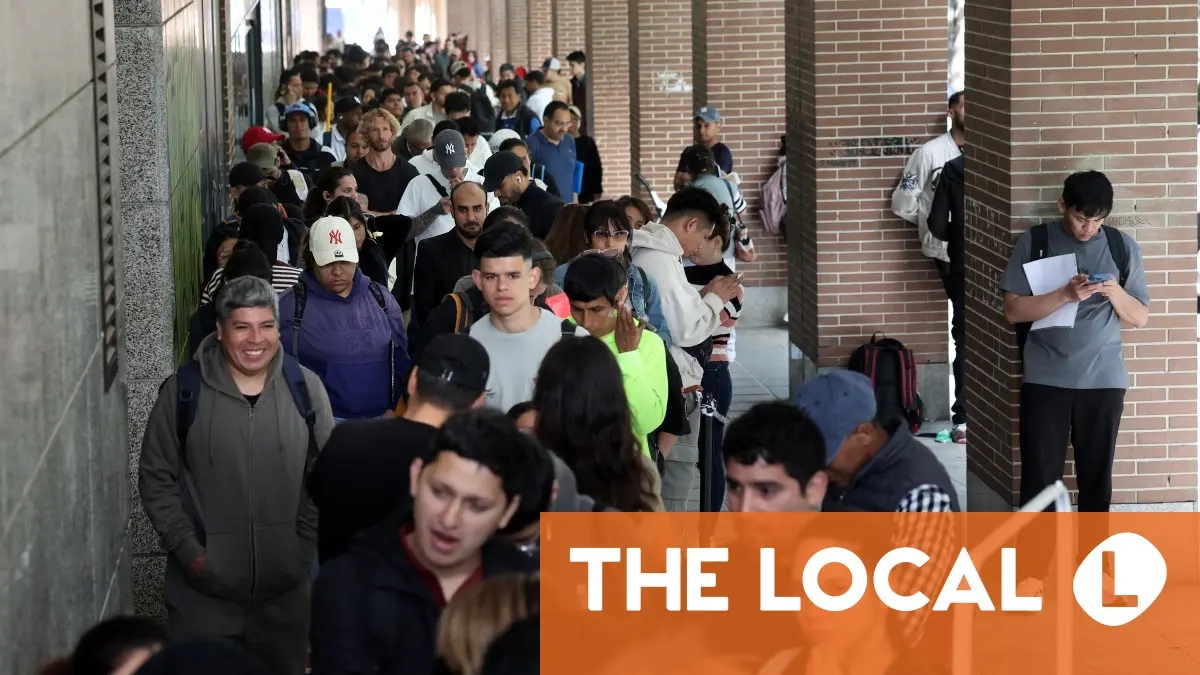
The divisive mass regularisation of undocumented migrants in Spain reaches a record 900,000 applications two weeks from the deadline, 400,000 more than initially forecast by the Spanish government and with police unions warning of cases of fraud.
There are still two weeks to go until the deadline for Spain’s mass regularisation process on June 30th, and already the number of applicants has far exceeded expectations.
According to a report in Spanish newspaper El País, based on government sources, there have already been 900,000 applications.
READ ALSO: How to apply for Spain's migrant regularisation
Initially, the Spanish government estimated there would be around 500,000 applying.
However, Spanish think-tank Funcas put the number at around 840,000 undocumented migrants already living in Spain at the beginning of January 2025.
According to El País, authorities have accepted a further 360,000 applications for processing, with two weeks still remaining before the deadline on June 30th.
The Spanish Ministry of Inclusion, Social Security and Migration has not yet released updated official data on the number of applications submitted.
Spain's Unified Union of the National Police (SUP) warned this Monday of "the proliferation of fraud related to padrón town hall registrations, administrative appointments, and supporting documentation."
"Around 900,000 regularisation applications have already been submitted, a figure that far exceeds the forecasts that the Government itself publicly shared during the preparation of the process," the union said in a statement.
"The data currently available demonstrates that the police forecasts were much closer to reality than the official estimates used to justify the initial planning of the process."
Aside from the forged documentation, SUP spoke out about other setbacks such as staff's "administrative overload, difficulties in obtaining certain international documents, and increasing pressure on the offices and units responsible for managing the process."
READ ALSO: The myths surrounding Spain's mass regularisation of migrants
The controversial amnesty was approved by the Spanish government in April of this year with the aim of facilitating residence and work permits for undocumented migrants who were already living in Spain before January 1st, 2026.
Applicants meeting the requirements such as continuously residing in Spain for at least five months prior to the date of application and having a clear criminal record will be granted an initial one-year residency and employment permit.
Q&A: How Spain's mass regularisation of undocumented migrants will work
According to the latest data available, 86 percent of those applying are from Latin America. Most come from Colombia, which almost doubles the number of the second largest group, who are from Peru.
They are followed by Honduras and Venezuela, although a significant number of regularisations are also expected among Moroccans and Algerians.
READ ALSO: Unregistered Brits are applying for Spain's migrant amnesty
Given that migrants who arrived in Spain after January 1st, 2026, are excluded from the scheme, combined with “the difficulties in obtaining the required documentation” within the application window, the Global Citizenship Foundation (GCF) estimates that around 60 percent of applicants will be successful.
In 2005, the government of José Luis Rodríguez Zapatero also approved a mass regularisation. During that process they received 691,655 applications and granted 576,506 residency permits.
Spain's conservative People's Party (PP) also gave residency to more than 520,000 undocumented migrants in two different amnesties under the premiership of José María Aznar.
Please sign up or log in to continue reading

thelocal