
You Need a Sunscreen Combo You'll Reapply Just As Much As Your Lip Combo
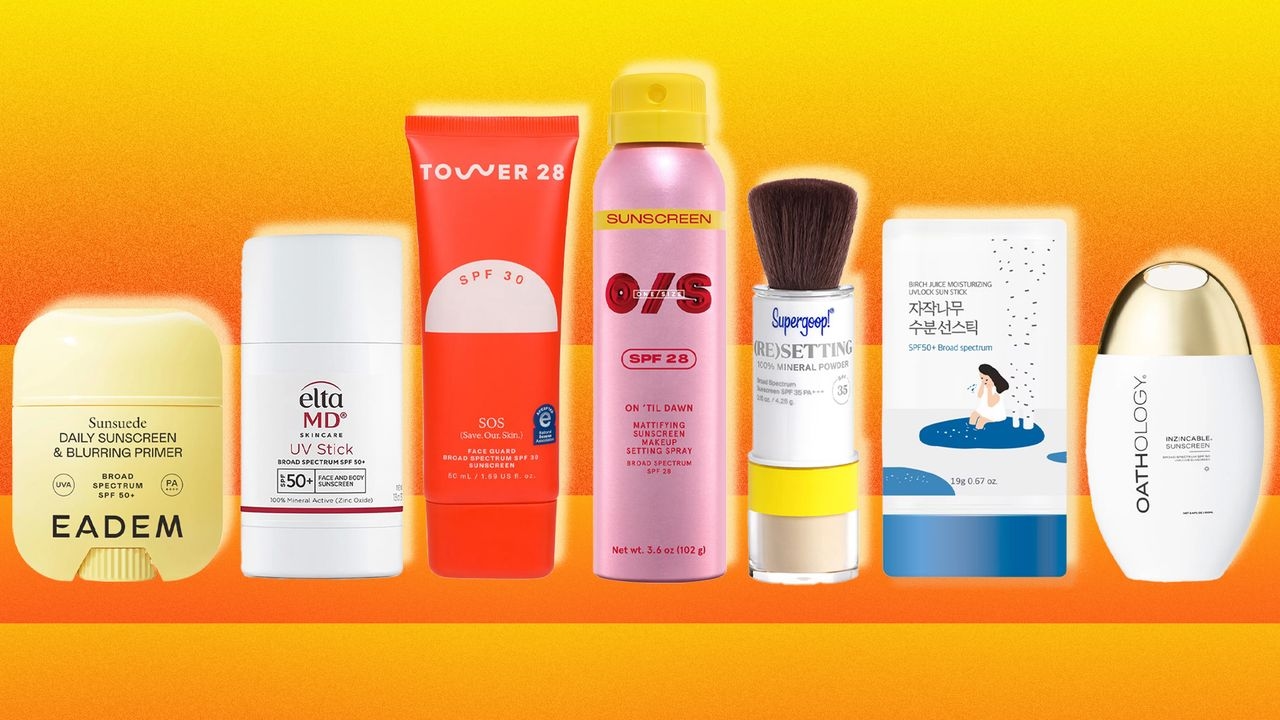
Summer is coming on full force, which means sunscreen is (or at least should be) top of mind. You might be super diligent about applying sunscreen in the morning, even if you are staying inside, but are you reapplying it throughout the day? If the answer is no, it's time to change that.
Finding the right sunscreen combo can help you stay on top of reapplication when you are on the go. SPF comes in a variety of shades, formulas, and formats these days, so you don't need to be lugging around a big tube of sunscreen to stay protected. Also, blaming your failure to reapply on wearing makeup is no longer understandable.
Whether you are on the go, traveling, busy at home or work, we have tapped experts to share everything you need to know about reapplying sunscreen during the day and what to look for when choosing your sunscreen combo. Keep reading for all their tips and tricks.
Meet the expertsIs sunscreen reapplication a must? And how often should we be reapplying it?If you are wondering whether you need to reapply sunscreen throughout the day, the answer is an absolute yes. Morning application is simply not enough on its own. "That morning layer isn't a force field," explains Divya Shokeen, a board-certified dermatologist and founder of OSVI Dermatology and Surgical Institute. "UV filters break down as they work, and the rest sweats, rubs, and towels off. No sunscreen lasts all day."
Dr. Shokeen recommends reapplying sunscreen "every two hours as a baseline, and every 40-80 minutes if you're sweating or swimming."
You should reapply sunscreen no matter the season, especially if you are outdoors, says Kseniya Kobets, a board-certified dermatologist and director of cosmetic dermatology at Montefiore Einstein Advanced Care. But summer is especially crucial since you'll presumably be getting more sun exposure than other times of year.
"During the summer, people tend to spend longer periods outside, so reapplication becomes even more important," Dr. Kobets points out. “Most people think sunscreen simply wears out, but what actually happens is that it gets removed from the skin. Sweat, swimming, toweling off, clothing friction, hair, masks, and even touching your face can gradually thin and disrupt the sunscreen film."
She continues, "Reapplication helps restore more even coverage and maintain consistent UV protection throughout the day, reducing the risk of sunburn, premature aging, discoloration, and skin cancer. While mineral sunscreens are usually removed primarily through rubbing and physical wear, chemical sunscreens may also become less effective over time with continued UV exposure.”
What should we look for when choosing a base sunscreen?"Choosing a sunscreen is very personal," Dr. Kobets says, and ultimately “the best sunscreen is the one you'll actually enjoy wearing and apply consistently.”
When looking for an everyday sunscreen, though, there are a few things that should be top priorities—and Dr. Shokeen has given us a quick, easy checklist: "Broad spectrum, SPF 30+, water-resistant if you're active."
Dr. Kobets cosigns broad-spectrum SPF 30 to 50, and tends to favor mineral sunscreens with zinc oxide and titanium dioxide: "They're effective, well-tolerated, and provide complementary protection across the UV spectrum, with many newer formulations offering little to no white cast and a variety of tint options," she says.
“Mineral sunscreens work by creating a protective layer on the skin that reflects, scatters, and absorbs UV radiation,” she explains further. "Zinc oxide provides excellent UVA coverage, while titanium dioxide is particularly effective in the UVB range. Many newer mineral sunscreens combine both ingredients for broad-spectrum protection, although zinc oxide-only formulas can also be an excellent option. Mineral sunscreens also begin working immediately after application because they sit on the skin's surface rather than needing time to absorb."

CeraVe
Invisible Mineral Sunscreen SPF 50 FaceDr. Kobets notes, too, that mineral sunscreens are often better tolerated by those with skin sensitivities, such as eczema, rosacea, and dermatitis.
Choosing a sufficient SPF is key, but it's also crucial not to feel a false sense of security just because you select a higher number. "It's important to remember that SPF is not a measure of how long you can stay in the sun; it reflects the level of UVB protection provided," Dr. Kobets explains. “For example, SPF 30 blocks about 97% of UVB rays. In real life, reapplication is often more important than choosing between SPF 30 and SPF 50 because protection decreases as sunscreen wears off throughout the day. Newer sunscreens also provide PA++++ information for UVA protection and, ideally, your sunscreen should have both UVB and UVA protection.”
If you have melasma, hyperpigmentation, or post-acne marks, Dr. Kobets says, tinted sunscreens “can be particularly helpful because many contain iron oxides, which may provide additional protection against visible light, including blue light," noting that "visible light can worsen discoloration, particularly in individuals with darker skin tones.”
If you are a teen or young adult with acne, a tinted formula might also be your best route. "I often tell patients that even if you only get one pimple a month, that's 12 potential dark marks a year, 24 after two years, and so on," Dr. Kobets says. “Those marks can accumulate over time, making daily sun protection one of the simplest ways to help prevent long-lasting discoloration. For many patients, preventing the mark left behind is just as important as treating the acne itself.”
Dr. Kobets suggests looking at CeraVe, Neutrogena, La Roche-Posay, Colorescience, EltaMD, Avène, Alastin, and DRMTLGY for a variety of tinted sunscreens. Some of her favorite lotion-based tinted mineral sunscreens are the Neutrogena Mineral UV Tint SPF 30, which she says "tends to work particularly well for cooler skin tones," and the CeraVe Hydrating Mineral Sheer Tint SPF 30, which she says "is often a great option for warmer skin tones."
Neutrogena
Purescreen+ Tinted Sunscreen for Face SPF 30CeraVe
Hydrating Mineral Sunscreen Face Lotion with Sheer Tint SPF 30For acne-prone skin, Dr. Shokeen recommends the untinted Inzincable sunscreen by Oathology. "It has azelaic acid to help with breakouts, and a clip-on so it's easy to carry for reapplication," she says. If you want a tinted option, she also recommends a mineral sunscreen like Colorescience, adding that these work great "when someone needs visible-light protection too." Both of these options are “broad spectrum and elegant enough to actually use,” she adds.

Oathology
Inzincable® Hybrid Untinted Sunscreen SPF 50+Dr. Shokeen confirms that "the best sunscreen is the one you'll reapply." She is also fully on board with having one product as your SPF base and then a different reapplication product. "Use an elegant lotion under makeup in the morning, then touch up with whatever's convenient to carry," she says. "They don't need to match; reapplication actually happening is the win."
Dr. Kobets agrees that "the key is making reapplication realistic and convenient," adding that "a sunscreen combination that encourages consistent use is often more effective than relying on a single product that people don't want to reapply."
Instead of focusing on specific combos, Dr. Shokeen says, you should focus on matching "the format to the moment." What does that mean? "Lotion or spray over bare skin. A powder, stick, or cushion compact over makeup. They all work; the catch is using enough, not the format."
Now, with more detail, let's jump into the alternative SPF products that are useful for reapplication:
Dr. Kobets says she loves stick sunscreens for on-the-go reapplication because “they're portable, mess-free, and easy to apply around high-risk areas like the nose, ears, forehead, hairline, and other exposed areas of the body.” One of her cosigns is the ELTA MD Zinc Stick.

EltaMD
UV Stick Sunscreen for Face and Body, Mineral SPF 50+As a beauty writer, one of my favorite combos for sun sticks—which works great with light makeup—is using the Round Lab Birch Juice Moisturizing UVLOCK SPF 45 as a base, then the Birch Juice Moisturizing UVLOCK Sun Stick SPF 50 for touch-ups during the day.
ROUND LAB
Birch Juice Moisturizing UVLOCK SPF 45ROUND LAB
Birch Juice Moisturizing UVLOCK Sun Stick SPF 50"Powder sunscreens and brush-on mineral powders are excellent for touch-ups throughout the day, especially over makeup, but they should not replace your primary sunscreen application," Dr. Kobets warns. "I frequently recommend them for reapplication, spot treatment, and protecting the part in your hair if you're not wearing a hat."
Some of her recommendations include ISDIN, which she says "offers a universally flattering light tint," and Colorescience, which "offers tinted and untinted versions." Another option is the Supergoop mineral powder, which “contains zinc oxide and has recently become popular among people with oily skin,” she says, "because it helps absorb excess shine."
If powder sounds like the choice you are aiming for, but you have dry skin, be warned: "These powders tend to be a bit more drying, which makes them a nice option for oily or acne-prone skin types," Dr. Kobets says. "I often recommend using them on high-exposure areas such as the face, chest, shoulders, arms, and even the knees during outdoor activities."
ISDIN
Mineral Brush PowderSupergoop!
100% Mineral (Re)setting Powder Face Sunscreen SPF 35Another oft-forgotten SPF format that Dr. Kobets recommends for reapplication is tinted mineral compact sunscreens. "I love compact formulations because they can be reapplied over areas that tend to burn first, such as the nose, cheeks, and forehead, while also providing a little cosmetic coverage," she says. “They're especially useful for patients who are prone to hyperpigmentation and want additional visible-light protection throughout the day.”
Her top recommendations are the SkinBetter compact and the Avène High Protection Tinted Compact SPF 50. "They provide substantial mineral coverage, layer well throughout the day, and offer excellent coverage for redness and discoloration, although they are on the thicker side," she notes. Round Lab also offers a Birch Juice Moisturizing UVLOCK Sun Cushion SPF 50, which works like a compact without a tint.
Dr. Kobets also notes that, while spray sunscreens can be convenient, achieving adequate coverage can be challenging. So they shouldn't be your base sunscreen, but if you are diligent, they can be a great option for midday reapplication, or for protecting frequently neglected areas like your scalp.
While having a sunscreen combo is great, you don't need a second product to reapply. If you're not wearing any makeup, you can 100% reuse the same SPF you used in the morning. My personal favorite if I'm not wearing makeup is reapplying the Hailey Bieber-approved ISDIN Fusion Water Magic. It's super lightweight and refreshing, so even on the go—and without a mirror for application—it's a piece of cake.
"Sunscreen layering is actually one of the most practical approaches," Dr. Kobets agrees. "If you already have a sunscreen lotion you love, simply reapplying that same sunscreen is often the easiest and most effective strategy."
You can also double up with two different types of lotions. "Many of my patients use a non-tinted sunscreen lotion as their morning base and then add a tinted sunscreen where they want a little extra coverage," Dr. Kobets explains. "For example, you can apply EltaMD UV Skin Recovery to the entire face and neck and then layer a tinted mineral sunscreen over areas such as the T-zone, cheeks, or under the eyes where you want additional coverage. I usually avoid applying the tinted product to the neck since it can transfer onto clothing."
Don't stick to only sunscreen
While being mindful of reapplication is already doing more than most, sun protection is not limited to sunscreens. "Sunscreen is only one part of a comprehensive sun-protection strategy," Dr. Kobets says. “I also encourage patients to wear hats, seek shade when possible, and use UV-protective clothing when spending prolonged periods outdoors.”
Shop more SPF products recommended by dermatologists and editors:La Roche-Posay
Anthelios UVAir Mineral Serum Sunscreen SPF 50La Roche-Posay
Anthelios Mineral Ultra-Light Face Sunscreen Fluid SPF 50EltaMD
UV Skin Recovery Face Sunscreen with Zinc OxideEltaMD
UV Clear Face Sunscreen SPFISDIN
Eryfotona Actinica SPF 50+Colorescience
Total Protection No-Show 100% Mineral Sunscreen SPF 50Doctor Babor
Mineral Sunscreen SPF 30EADEM
Sunsuede SPF 50+ Lightweight Sunscreen & Blurring Primer StickTarte
creaseless SPF 30 mineral powderCetaphil
Sheer Mineral Sunscreen Stick SPF 50Bubble Skincare
Sun Rise Mineral Sunscreen Stick Broad Spectrum SPF 40
teenvogue