
RBI likely to keep status quo on policy rate as threats loom

Mumbai: The Reserve Bank of India is likely to leave the policy rate unchanged at its June meeting, according to a majority of economists in an ET poll, amid geopolitical tensions and adverse weather forecasts that pose risks to economic growth and threaten to fan inflation.Eleven of the 15 economists in the survey predicted a pause on the repo rate during the June 3-5 Monetary Policy Committee (MPC) meeting, while four forecast a 25-basis point, or quarter-percentage point, increase.RBI sees services exports, remittances cushioning current account in FY27For the fiscal year, 13 of them expect a cumulative rate hike of 50-75 basis points. The other two see the central bank extending its pause through the year. MPC kept the rate unchanged at 5.25% at its April meeting. 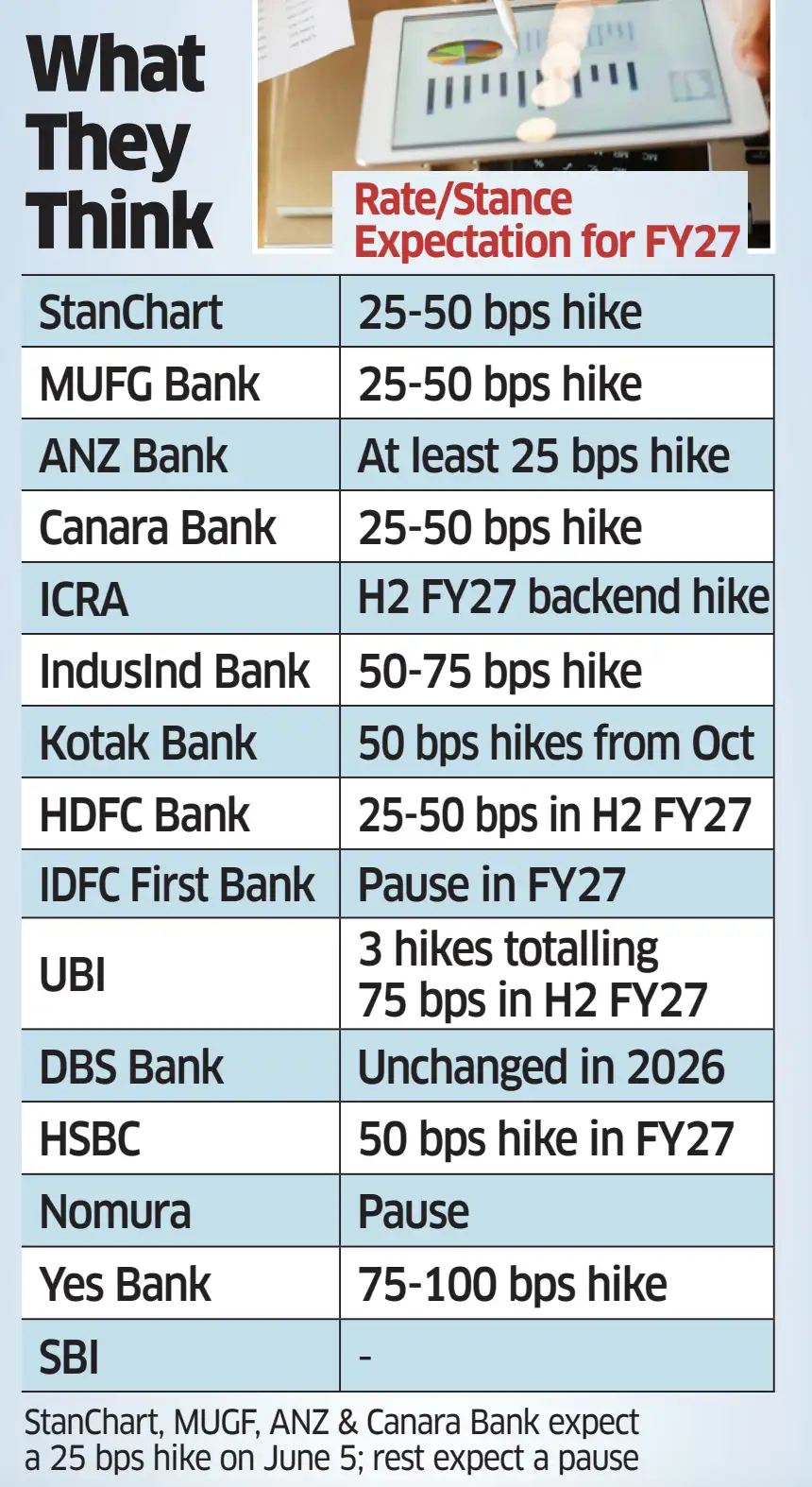 The June meeting comes in the backdrop of rising fuel prices and a sharply weaker rupee driven by the US-Iran war, as well as the threat of El Nino conditions that could affect monsoon and, in turn, hurt food production and drive up prices.India faces test of oil, inflation and monsoon risks despite economic resilience, says FinMinEconomists favouring a pause see current inflationary pressures as largely supply-driven and, therefore, less responsive to higher interest rates. Raising borrowing costs in such an environment would do little to curb price pressures while risking a further slowdown in economic growth, they said. "The West Asia war has caused a supply-side shock," IDFC First Bank chief economist Gaura Sen Gupta told ET.Inflation Focus“The West Asia war has caused a supply-side shock,” IDFC First Bank chief economist Gaura Sen Gupta told ET.“Monetary policy is not the ideal tool to respond, given that it operates primarily through the demand channel. A rate hike to address inflation risks would only exacerbate demand destruction,” said Sen Gupta of IDFC First.Economists expecting a hike, however, said monetary policy should remain focused on anchoring inflation expectations.“After hikes in petrol prices, I expect the FY27 inflation to be 5.0-5.5%, and I also expect one more round of fuel price hike. In such a situation, inflation is expected to increase. So, I think the RBI should consider a hike now, instead of waiting to hike during future policies,” Canara Bank chief economist Madhavankutty G told ET, predicting a quarter-percentage-point hike.Anubhuti Sahay, head of India economic research at Standard Chartered Bank, also expects a 25-bp hike and projected the RBI to revise its inflation projection to 4.9% for FY27. The rupee’s sharp depreciation raises the risk of second-order effects on consumer inflation, strengthening the case for a hike, Sahay wrote in a report.The RBI in April projected inflation to average 4.6% and the economy to grow 6.9% in fiscal 2027.Some of the economists expect the RBI to announce measures that address the capital outflow problem battering the local currency. Institutions like MUFG, Canara Bank and Nomura expect measures like tightening limits under the Liberalised Remittance Scheme and further forward hedging restrictions.“The rapid return of depreciation pressures points to the need for more sustained policy support in periods of heightened global uncertainty,” State Bank of India said in a note on Sunday.The rupee declined nearly 11% in FY26 and another over 3% in FY27 so far.The RBI started reducing policy rates from February 2025, and cut it by 125 bps to 5.25%, with the latest cut delivered in December 2025. Since then, the MPC has kept a status quo on rates.“Even as CPI inflation outcomes durably breach RBI’s 4% target, we believe the MPC will look through this as supply shock and persist with its ‘neutral pause’,” Aastha Gudwani, chief India economist at Barclays, said in a report.
The June meeting comes in the backdrop of rising fuel prices and a sharply weaker rupee driven by the US-Iran war, as well as the threat of El Nino conditions that could affect monsoon and, in turn, hurt food production and drive up prices.India faces test of oil, inflation and monsoon risks despite economic resilience, says FinMinEconomists favouring a pause see current inflationary pressures as largely supply-driven and, therefore, less responsive to higher interest rates. Raising borrowing costs in such an environment would do little to curb price pressures while risking a further slowdown in economic growth, they said. "The West Asia war has caused a supply-side shock," IDFC First Bank chief economist Gaura Sen Gupta told ET.Inflation Focus“The West Asia war has caused a supply-side shock,” IDFC First Bank chief economist Gaura Sen Gupta told ET.“Monetary policy is not the ideal tool to respond, given that it operates primarily through the demand channel. A rate hike to address inflation risks would only exacerbate demand destruction,” said Sen Gupta of IDFC First.Economists expecting a hike, however, said monetary policy should remain focused on anchoring inflation expectations.“After hikes in petrol prices, I expect the FY27 inflation to be 5.0-5.5%, and I also expect one more round of fuel price hike. In such a situation, inflation is expected to increase. So, I think the RBI should consider a hike now, instead of waiting to hike during future policies,” Canara Bank chief economist Madhavankutty G told ET, predicting a quarter-percentage-point hike.Anubhuti Sahay, head of India economic research at Standard Chartered Bank, also expects a 25-bp hike and projected the RBI to revise its inflation projection to 4.9% for FY27. The rupee’s sharp depreciation raises the risk of second-order effects on consumer inflation, strengthening the case for a hike, Sahay wrote in a report.The RBI in April projected inflation to average 4.6% and the economy to grow 6.9% in fiscal 2027.Some of the economists expect the RBI to announce measures that address the capital outflow problem battering the local currency. Institutions like MUFG, Canara Bank and Nomura expect measures like tightening limits under the Liberalised Remittance Scheme and further forward hedging restrictions.“The rapid return of depreciation pressures points to the need for more sustained policy support in periods of heightened global uncertainty,” State Bank of India said in a note on Sunday.The rupee declined nearly 11% in FY26 and another over 3% in FY27 so far.The RBI started reducing policy rates from February 2025, and cut it by 125 bps to 5.25%, with the latest cut delivered in December 2025. Since then, the MPC has kept a status quo on rates.“Even as CPI inflation outcomes durably breach RBI’s 4% target, we believe the MPC will look through this as supply shock and persist with its ‘neutral pause’,” Aastha Gudwani, chief India economist at Barclays, said in a report.
economictimes