
MoSPI proposes framework to measure India's knowledge economy contribution

New Delhi: The statistics and programme implementation ministry ( MoSPI) on Saturday released a base paper proposing a framework to measure the contribution of knowledge and knowledge products to the Indian economy, as rapid technological change and evolving skill demands make knowledge increasingly central to economic activity.The framework aims to capture the economic contribution of research and development, intellectual property, software, artificial intelligence (AI), digital platforms, scientific publications, innovation, creative industries, traditional knowledge systems and other intangible knowledge-based assets."Knowledge capital may depreciate over time. However, it may subsequently be revitalised with a change in the growth context or policy environment," said the paper, citing examples such as Ayurveda and technological revival in strategic sectors. Among the key proposals is the creation of an "effective R&D capital stock" measure. The ministry proposes to convert annual research expenditure into an estimate of accumulated knowledge capital using methods similar to those used in national accounts for measuring fixed capital formation. Its ongoing research on the knowledge economy seeks to develop a framework to assess the economic impact of knowledge and knowledge products, according to the paper. 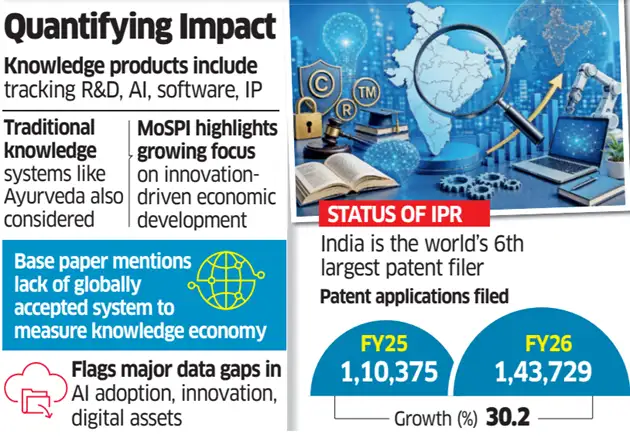 Difficult Exercise"This entails defining the scope of work, reviewing existing evidence, assessing the use of available data sources, identifying gaps and possibilities for generating additional information, and arriving at a feasible methodology to quantify the impact," it said.The ministry acknowledged that measuring the knowledge economy is a difficult exercise, noting that there is no global parallel or widely accepted conceptual framework for such measurement.It flagged data gaps related to innovation, digital assets, AI adoption and knowledge diffusion, indicating that new datasets and methodologies may be required before a comprehensive framework can be implemented.The ministry has also constituted a committee on knowledge systems under the chairmanship of Ratan P. Watal-former member secretary of the Economic Advisory Council to the Prime Minister-to prepare an actionable policy paper on measuring the contribution of knowledge and knowledge products to the economy. It has invited stakeholder feedback on the proposed paper by June 15.
Difficult Exercise"This entails defining the scope of work, reviewing existing evidence, assessing the use of available data sources, identifying gaps and possibilities for generating additional information, and arriving at a feasible methodology to quantify the impact," it said.The ministry acknowledged that measuring the knowledge economy is a difficult exercise, noting that there is no global parallel or widely accepted conceptual framework for such measurement.It flagged data gaps related to innovation, digital assets, AI adoption and knowledge diffusion, indicating that new datasets and methodologies may be required before a comprehensive framework can be implemented.The ministry has also constituted a committee on knowledge systems under the chairmanship of Ratan P. Watal-former member secretary of the Economic Advisory Council to the Prime Minister-to prepare an actionable policy paper on measuring the contribution of knowledge and knowledge products to the economy. It has invited stakeholder feedback on the proposed paper by June 15.
economictimes