

Germany wants to show Syrians the door

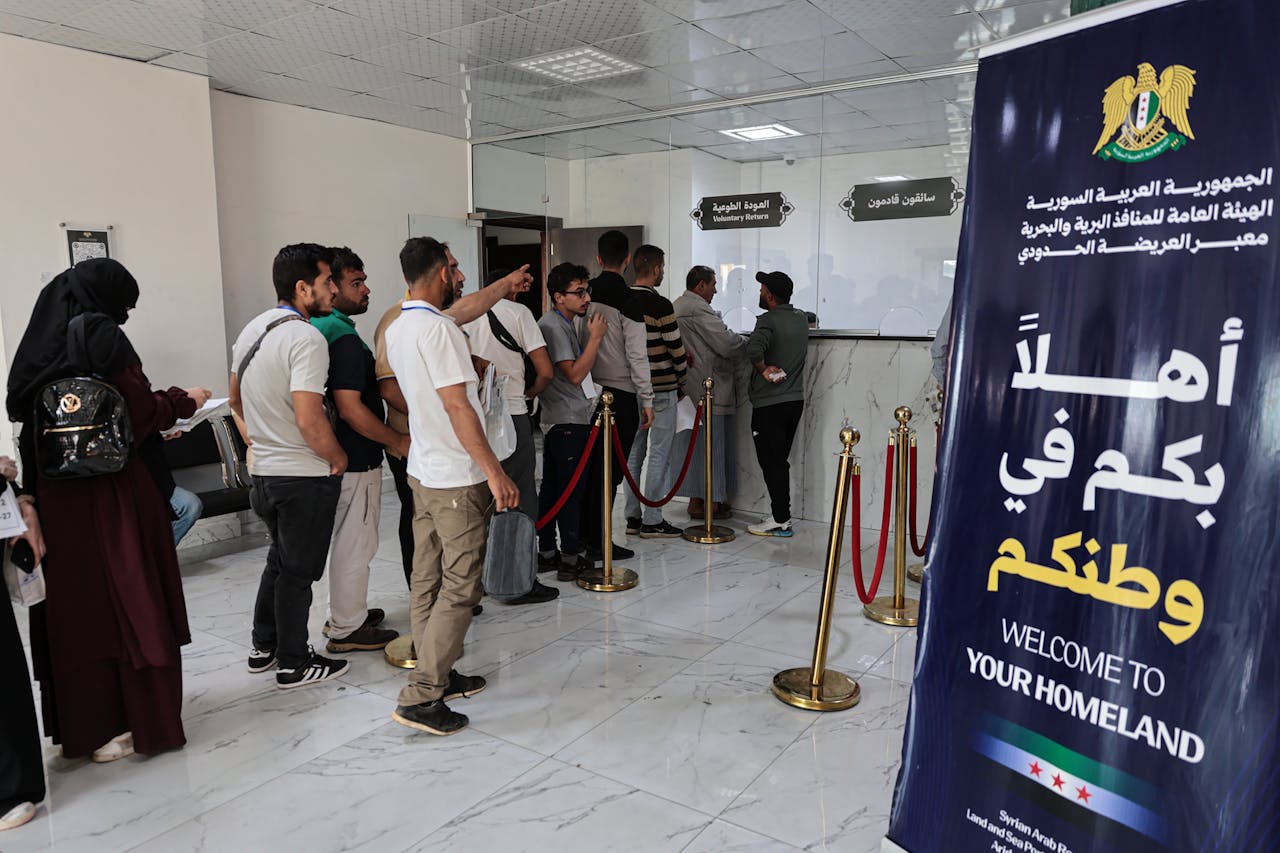
German politicians have been heatedly debating Syrian asylum seekers for a week now that the war in their country has subsided.
Manfred Weber, the head of the European Christian Democrats in the European Parliament, has now weighed in on the debate. Weber told the Bild newspaper on Sunday last weekend that "we help in times of need, but when the war is over, you have to return to your country."
This is an issue that deeply divides German Christian Democrats. Foreign Minister Johann Wadephul recently visited Syria and saw how devastated the country is. He concluded that no one can be forcibly sent back at this time.
Numerous Christian Democrats criticized him; the coalition agreement between the CDU/CSU and the SPD stipulates a stricter migration policy. Critics interpreted Wadephul's remarks as implying that the minister no longer wanted to continue the deportation of Syrians guilty of crimes.
Chancellor Friedrich Merz expressed his support for his minister. But he also said that Syrians must help rebuild their country. "There is no longer a basis for asylum," Merz said .
In Bild am Sonntag, Manfred Weber says that "if deportations don't work in the first month because parts of Syria have been completely destroyed, they might work in the second." But back to Syria, that's what has to happen eventually. Unless Syrians make a significant contribution to Germany through employment, according to Weber.
Most asylum applications in Germany now come from people from Afghanistan, according to figures from the BAMF, the agency responsible for migration and refugees. Syrians are applying in increasingly fewer numbers. The German news agency DPA found that the government rejected 1906 Syrian asylum applications in October. Between January and September, that number was 163. Approximately 950,000 Syrians live in Germany.
In the Netherlands, most asylum applications still come from Syrians. Before the summer, the government announced that its policy towards Syrian asylum seekers would be changing due to the fall of the Assad regime. Last month, Trouw reported that the Immigration and Naturalization Service (IND) now rejects 85% of Syrian asylum applications.
2. AfD members traveling to Russia…
"Treasonous." The secretary general of the Bavarian Christian Democrats (CSU), Martin Huber, didn't mince his words when asked what he thought of a delegation from the far-right Alternative for Germany (AfD) traveling to a conference in Sochi, Russia.
It's well known that the AfD has a great deal of sympathy for the Russian perspective on the war in Ukraine. The German governing coalition is finding this increasingly unacceptable. Last month, Thuringian Interior Minister Georg Maier (SPD) even stated that the AfD has an unhealthy interest in the smallest details of German drone defenses and is very curious about infrastructure security.
These concerns are now not only being felt in Berlin and Erfurt, but also in Bavaria . Bavarian parliamentary chief Ilse Aigner is currently considering adjusting the state parliament's rules.
The AfD denies everything, and now there's the trip to Sochi. The AfD believes that the European sanctions against Russia are harming the German economy. They must therefore be scrapped. Other parties, however, believe the AfD is tarnishing Germany's reputation as a business location. The debate about banning the party revived last weekend.
Incidentally, the party's wanderlust isn't limited to eastward. The Frankfurter Allgemeine newspaper noted on Saturday that the AfD is also keeping an eye on the US. The party wants to learn from Trump and his associates to win, the newspaper reported .
…that spends less on weapons and more on words
In Russia's draft budget for 2026, military spending is $2.4 billion (€2.1 billion) lower than this year, while funding for state-run media is expected to increase 54% to $1.3 billion. According to Yuri Lapaiev of the American think tank Jamestown Foundation, this indicates that Moscow is shifting its focus from the battlefield to the hearts and minds .
Russian propaganda serves several purposes: to maintain domestic support for the war in Ukraine, to undermine Western willingness to help, and to weaken Ukrainian morale. For example, it glorifies its own army, portrays Western sanctions as ineffective, and portrays Ukrainian attacks in Russia as meaningless.
One of the techniques the Kremlin uses is setting up social media accounts that initially share pro-Ukrainian content. Once these accounts gain sufficient followers, they begin spreading messages about alleged catastrophic losses suffered by Ukrainian forces.
For its propaganda war, Moscow is embracing the latest technology, Lapaiev says, including by distributing fake videos designed to convince new Ukrainian recruits to surrender or flee. These images are often generated using artificial intelligence.
To bolster opposition to aid to Ukraine, Moscow is also resorting to provocations such as drones flying over European infrastructure. Last week, there was a lot of commotion, especially in Belgium, about unwanted drones flying over airports and military areas.
According to the Belgian security service, it's almost certain that Russia is behind this drone traffic—a sign that the Russian billions at Euroclear should remain where they are. Moscow denies any involvement, which could be a clever example of disinformation.
Would you like to receive this Europe newsletter by email every week? Subscribe here. And here are previous issues .
The Court of Justice of the EU will deliver a ruling on Tuesday on the EU minimum wage directive. The Danish (and Swedish) government believes this issue falls within the competence of EU member states. Read here how the plan was developed in 2022.
The finance ministers of the eurozone countries are meeting on Wednesday . Here's the agenda . The non-eurozone countries will join the meeting a day later , and then they'll discuss customs issues, among other things. Also read the Shein story by FD Brussels resident Daan Ballegeer.
On Wednesday , European Commissioner Henna Virkkunen will present the "European Democracy Shield," a plan to make democracy more resilient to foreign interference. Brussels will also present a strategy for strengthening and protecting civil society.
The mayors of Hamburg, Rotterdam, and Antwerp are visiting Magnus Brunner, the European Commissioner for Home Affairs and Migration, on Wednesday . The three mayors met in April 2024 to discuss measures against drug trafficking.
• Think tank Bruegel will debate the EU's dependence on the US defence sector on Wednesday .
The European Parliament will debate the multiannual budget on Wednesday . There's a chance that the representatives will reject the European Commission's plan due to its intention to place subsidies for agriculture and regional projects in national portfolios. The Commission has already made a concession . Read this analysis as well.
The Catalan issue will be brought before the Court of Justice of the European Union on Thursday . The Court will then issue an opinion on how the highest European court should handle Spain's 2024 amnesty law for politicians who advocate for Catalan independence.
• Think tank Ceps will focus on the Greek debt crisis on Thursday and how the country escaped it.
Also on Thursday : the European Parliament will vote again on the anti-look-a-way law, which obliges companies to address abuses in their production chains. The issue is causing tension among MPs.
• Italian President Sergio Mattarella will visit his German counterpart Frank-Walter Steinmeier on Saturday and Sunday .
Read (and listen) more?Belgium opposes the continued deposit of Russian assets with the Euroclear securities depository due to the significant legal risks. Slovak Prime Minister Robert Fico is also opposed, but for a different reason : Ukraine simply should not receive funding for military expenditures.
Russian Maneuvers This podcast from think tank ECFR examines what Russia is doing in Africa.
Bears on the Road The Polish branch of Greenpeace has filed a complaint with the European Commission over Slovakia's plan to cull 350 bears . According to the environmental organization, this would violate EU law and pose a threat to Poland's small population of 130 bears.
Boosts for Viktor The Orbán government is tightening its grip on the Hungarian media, with a media group with ties to it acquiring the popular Blikk from Swiss publisher Ringgier. And on Friday, Donald Trump came to Viktor Orbán's defense in the debate over Russian energy.
Immigrants in France transfer part of their salaries abroad to support family. This represents a €10 billion annual loss for the French economy, according to the conservative newspaper Le Figaro.
Europamania is written by FD Brussels writers Daan Ballegeer and Mathijs Schiffers , plus Han Dirk Hekking . Do you have any comments or news? Let us know at [email protected] .

fd.nl



%2Fs3%2Fstatic.nrc.nl%2Fwp-content%2Fuploads%2F2025%2F11%2F10173001%2F101125VER_2022819851_2.jpg&w=1280&q=100)
%2Fs3%2Fstatic.nrc.nl%2Fwp-content%2Fuploads%2F2025%2F11%2F10213750%2F101125VER_2022883282_.jpg&w=1280&q=100)
%2Fs3%2Fstatic.nrc.nl%2Fwp-content%2Fuploads%2F2025%2F11%2F10215011%2F101125VER_2022885911_.jpg&w=1280&q=100)