

Rock around the Christmas tree with the best music books of 2025
By MARK MASON
Published: | Updated:
Into the Groove is available now from the Mail Bookshop
THIS has got more Eighties pop facts than you can shake a Walkman at, from the reason for the title of Q Magazine (it referred to ‘cueing up’ a CD) to the original name of the Pogues (Pogue Mahone, which is Gaelic for ‘kiss my a**e’, hence the BBC refusing to use it).
Even if you’re a confirmed vinylista, I guarantee there will be facts in here that you didn’t know.
I was aware, for instance, that Ronnie Scott played the saxophone solo on the Beatles’ Lady Madonna, but I wasn’t aware that he performed the same function on I Missed Again by Phil Collins.
And as with all the best trivia, the passage of time brings a whole new perspective.
The 1989 episode of Robert Kilroy-Silk’s BBC1 programme discussing acid house parties was no doubt interesting enough in itself. But it’s all the more intriguing now, as we note that one of the participants was a young lawyer from the National Council for Civil Liberties by the name of Keir Starmer.
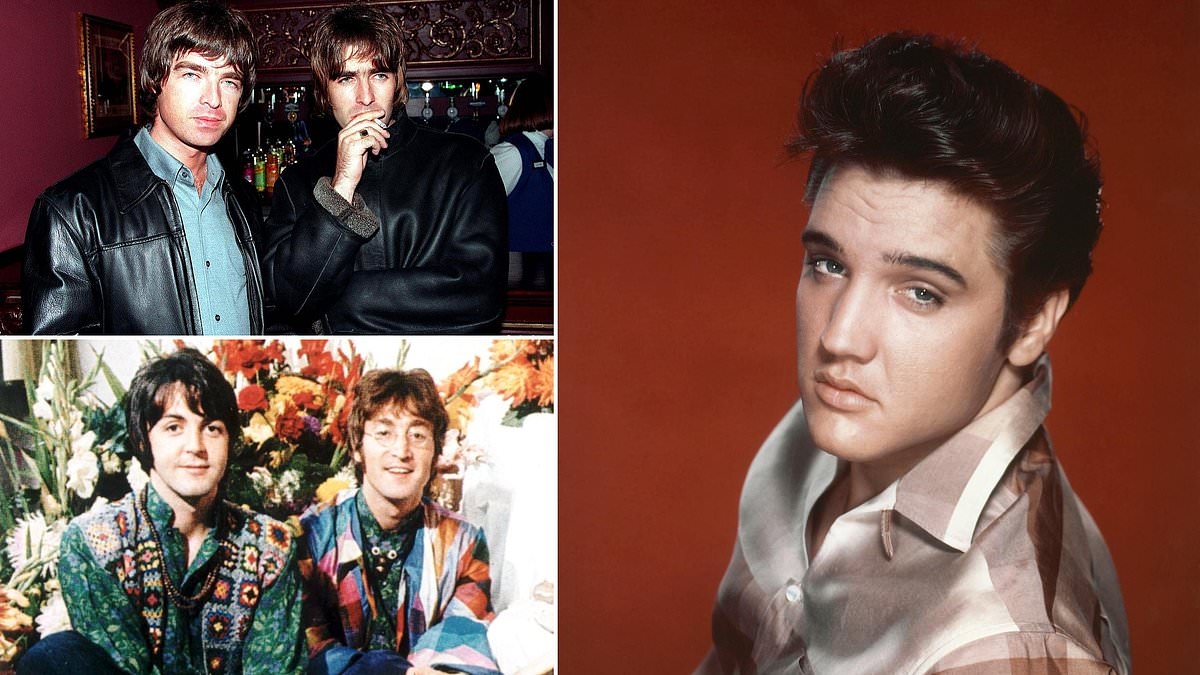
It’s more than 50 years since the Beatles split up, and nearly 70 since John Lennon and Paul McCartney met, yet still there are books being written about the biggest band ever and the relationship at its heart.
There’s always something new to tickle your Fabs fancy. In this book we learn that on their trip to Paris in 1961, John and Paul couldn’t afford to go up the Eiffel Tower, so contented themselves with lying on the grass underneath and staring up at it. (The same holiday contained John’s 21st birthday – Paul bought him a hamburger and a Coke.)
We learn that John passed his driving test on the same day he recorded Ticket To Ride, and that for the famous ‘never-ending’ chord at the end of A Day In The Life, the pair (together with Ringo Starr, producer George Martin and roadie Mal Evans) stood up so they could maximise the force with which they hit the piano keys.
And we learn that John’s last words to Paul, in a phone call, were ‘think about me every now and then, old friend’.
Live Forever is available now from the Mail Bookshop
For their first foreign gig, Oasis took the ferry to Holland. They paid for their champagne and Jack Daniel’s with fake £50 notes, while Liam Gallagher ran around the casino ‘throwing chips in the air’.
It isn’t specified whether these were of the gambling or edible variety, but either way, as soon as the ferry docked the band were sent straight back to the UK. Noel Gallagher rang their record company boss to inform him of events. ‘He didn’t say, “You will never work again”,’ remembers Gallagher. ‘He said, “F*****g brilliant . . . normally we have to make stories like that up”.’
Antics of this nature, and some of the most memorable songs of the decade, made Oasis rulers of the 1990s. This biography analyses their supersonic journey in microscopic detail.
For example, the reason Liam is lying down on the cover of their first album Definitely Maybe is that the photographer had just seen an exhibition of Egyptian mummies in Manchester Museum. Meanwhile, the red wine in the shot is actually Ribena – it photographed better.
Guralnick knows Elvis Presley like no one else – he’s the king of the King. His two-volume Presley biography (1994’s Last Train To Memphis, followed five years later by Careless Love) is seen as definitive.
Now comes this book about the star’s relationship with his manager, ‘Colonel’ Tom Parker (no military service was involved – the Dutch immigrant Andreas Cornelis van Kuijk invented both his title and his new name).
Elvis and his music came to mean so much to so many people: Frank Skinner says he remembers trying not to blink as he watched the famous 1968 Comeback Special programme, so scared was he of missing anything.
It’s sad, then, to be reminded of just how much misery Presley and Parker experienced on the inside of the tale.
Parker was a hopeless gambler, losing as much as $800,000 (£600,000) at a single sitting.
And Presley died at 42, bloated and drug-addicted. Would he have preferred never to have found fame?
Even in the early days of his success, he said how much he envied a dog he heard howling in the night: ‘That dog has a life of his own. He goes out at night, and he’s doing this, and he’s doing that, and nobody knows what he’s up to, but he’s having more fun – and when the sun comes up he’s back under the porch sleeping, and nobody knows what a wonderful life he’s living during the night.’
John Williams is available now from the Mail Bookshop
In early 1977, the director George Lucas showed several of his friends an early cut of his new film Star Wars.
Their reaction was so negative that Lucas’s wife ended up sobbing. A few weeks later, after the first day of recording John Williams’s music for the movie, Lucas began to recover his confidence.
‘It was like the sun came out again,’ said a friend. ‘He was the old George.’
Play that theme in your head (I bet you can, without having to look it up), and you’ll understand Lucas’s reaction.
Williams’s film scores have been the soundtrack of most of our lives, from Jaws and E.T. to Jurassic Park and Harry Potter.
Greiving’s expansive biography documents the composer’s life, revealing the secrets behind some of the most listened-to music of the past 50 years.
That Star Wars theme is in B-flat major, because George Lucas insisted on opening the film with the old 20th Century Fox ‘searching spotlights’ sequence, and Williams wanted the keys to match.
Chris Columbus, director of the first Harry Potter film, was ‘dying to see what John would do with Quidditch . . . a sporting event that doesn’t exist, that we have to visually invent’. It’s a quote that makes you realise just how much weight is carried by a film’s music.
Williams’s daughter now says that her father is Harry Potter, and Greiving agrees: ‘A mild-mannered wizard with glasses, who casts spells and enchants the entire world.’

Daily Mail


