

France's Yellow Vests in search of a new voice
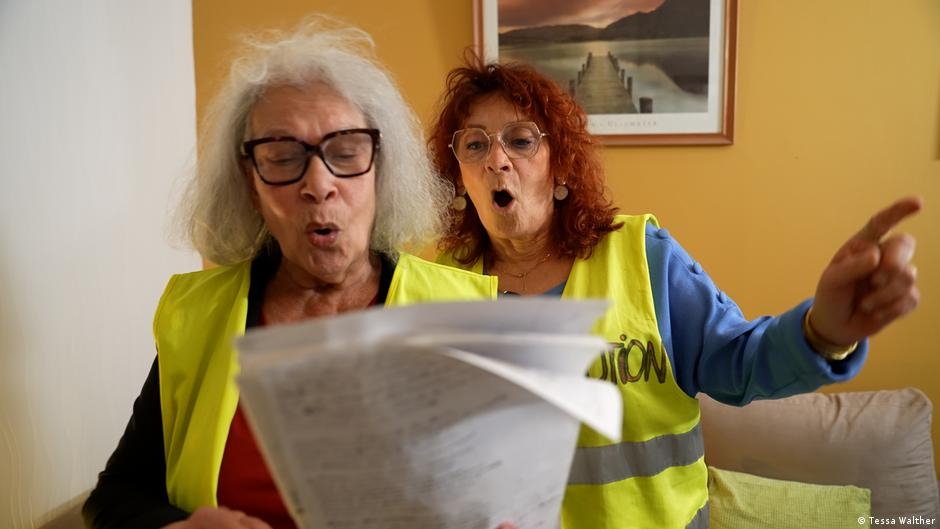
A theater rehearsal in northern France: Ten amateur actors and actresses have gathered in a community hall in Lille on a Sunday afternoon. Most of them don't know each other through the arts and theater scene; they met during the Yellow Vest protests in France.
The protest movement reached its peak in 2018 and 2019. At that time, demonstrators wearing yellow safety vests blocked roads throughout France to protest against an increase in fuel tax, which was also intended to finance climate protection measures.
Since then, the movement has become quieter. But many of the participants from back then haven't forgotten what it felt like to be part of the movement, which, due to its highly visible vests, is called "gilets jaunes" in French, or "yellow vests" in English.
One of the actresses present today, 66-year-old Marine Guilbert, has a yellow vest hanging from her backpack. Framed by two hand-painted butterflies, it bears the words "fiere d'etre un gilet jaune," which translates to "proud to be a yellow vest." One of the other actors teases her, suggesting she probably wears her vest to bed as well.
'Worse than before'At the height of the Yellow Vest movement, some demonstrators protested peacefully, while others threw smoke bombs, looted shops, and set fire to barricades . French police responded with water cannons and tear gas, leading to accusations of police brutality. According to data from the French online newspaper Mediapart, the protests resulted in four deaths and hundreds of injuries.

Seven years and many protests later, Guilbert is still angry about the political and economic situation in France. "It's worse than before," she complains to DW. As a cleaner, she earns less than 1,000 euros a month. To make ends meet, she relies on support from her son and food parcels from charities. She feels abandoned by the state. That's why she and her group are trying to express their frustration in other ways.
Guilbert can't remember the last time she went to the theater. "Too expensive," she remarks. But now she doesn't have to watch professional theater productions anymore, she says, pointing confidently at herself: "We're born artists."
The theatre group was founded by Anne-Sophie Bastin, a lawyer, and other Yellow Vest activists from Lille. "We saw so much violence, so much injustice at the hands of the police. That's why we decided to bring it to the stage," she explains. She founded the group, writes the plays, and also directs them.
The group made its debut in 2019. At that time, the play was about the Yellow Vest movement itself. The new play is scheduled to premiere at the end of November near Lille at the Wasquehal Theatre, which seats 400. It tells the story of Bobby Sands, a member of the paramilitary Irish Republican Army (IRA), revered as a hero by many Irish people but condemned as an extremist by others. Sands died in prison in 1981 at the age of 27 during a hunger strike. Bastin describes him as an inspirational figure.

During their street protests, the Yellow Vests managed without a leader. "They're not used to having a boss," Bastin says of her group. But here on stage, she is the boss. When one of the actors puts too much of his own interpretation into his character during rehearsal in October, Bastin intervenes: "I wrote the play."
In the past, the theater group consisted solely of Yellow Vest protesters. At that time, it had about 40 members. But members came and went, and eventually the group was opened to friends and family. Currently, it has 15 amateur actors.
France in crisisAs France stumbles from crisis to crisis, a new protest movement has come into focus in recent months. Calling itself "bloquons tout" ( let's block everything), it aims to paralyze all public life. When the French newspaper "Le Monde" conducted a poll in mid-October, 95 percent of respondents said they were dissatisfied with the state of the country.
Yolaine Jean Pierre, a retired woman and one of Bastin's amateur actresses, composes songs in her spare time. On the day of rehearsal, she wears a button on her collar depicting a yellow vest with a heart on it. She starts singing one of her songs, and the others join in. The catchy melody and lyrics linger in the mind long afterward. The theme is the same in all the songs: President Emmanuel Macron, who, in their eyes, is largely responsible for the state of France.
This discontent will not be easy to eliminate. France has a structural problem, says Julien Talpin, a political scientist at the University of Lille. "Because France's political system is no longer able to compensate for inequalities, the anger finds other outlets," he told DW.
One of the reasons for the government's instability is the lack of support for Macron in the French parliament. This prevents him from implementing the reforms he believes are necessary to help France out of its economic crisis.
Public debt in France exceeds 100 percent of the country's revenue, yet attempts by past governments to reduce public debt—ranging from reforming the French pension system to abolishing national holidays—have met with fierce resistance from the public and political opponents.
According to a recent report published by the French Inequality Observatory, the poverty rate in France has been rising for 20 years. However, it is unlikely that a change at the top of the state would automatically solve France's political problems. If Macron resigns, he risks handing the highest office in the country to the far-right National Rally party, experts say.
Yellow Vests demand Macron's resignationIn the community hall in Lille, most of the actors and actresses agree: they believe the president's resignation is long overdue. However, pensioner Jean Pierre doesn't think it will happen. She quips that Macron will cling to power because he thinks he's God.
Whoever is in power, little will change, another of the actors remarks. Paris feels far away. Cleaning lady Marine Guilbert channels all her desires for change into the theater. "I hope our voices will be heard both outside and on stage," she says.
Jean Pierre's eyes light up when she talks about the theatre group. "We [the members of this troupe] are fighting the same battle," she emphasizes to DW. "We think the same way. We are united."
Adapted from the English by Phoenix Hanzo.

dw


